
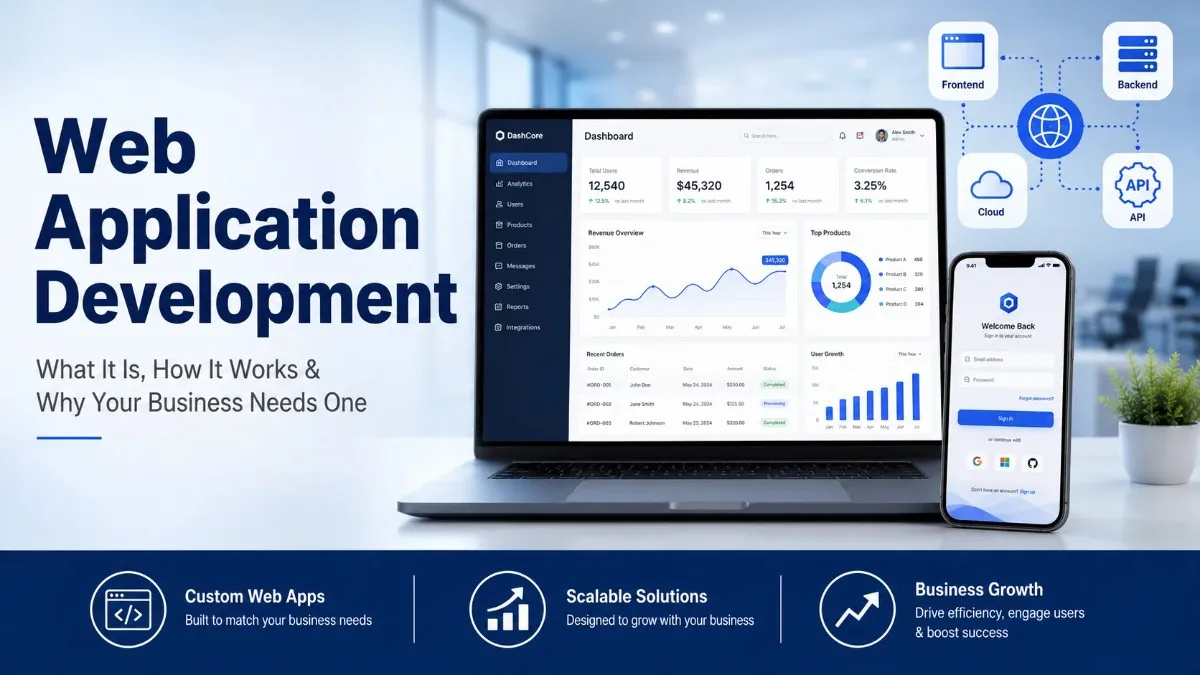
Web application development is one of those terms that gets used constantly in business conversations but rarely gets explained properly. Everyone knows they probably need a web app. Far fewer people can explain exactly what one is, how it gets built, or why it is a fundamentally different investment from a regular website.
This blog covers all of that in plain, simple terms, so by the end, you can make a genuinely informed decision about what your business actually needs.
What Is a Web Application, Exactly?
A web application is software that runs in a browser. Unlike a static website that just displays information, a custom web application responds to what you do. And that’s through processing input, storing data, performing calculations, and delivering a different experience based on who is using it and what they are doing.
The easiest way to understand this is through examples. Your online banking portal is a web application. Just like that, the project management tool your team logs into every morning is a web application. And the same with your booking system, which your clients use to schedule appointments.
Here is what separates a web application from a regular website:
- A web app has user authentication, so different people see different things
- Secondly, it reads and writes data in real time rather than just displaying fixed content
- Then it also performs logic on the server side, apart from the page
- Further, it can connect and work with different systems like payment processors, CRMs, or third-party APIs
- And lastly, it gives you a personalised experience by seeing user behaviour and the input they give.
The Web Application Development Process
Understanding how web applications are developed matters even if you are not the one writing the code. It helps you ask the right questions, set realistic timelines, and hold a development team accountable at every stage.
Steps to Build a Web Application the Right Way
Learning how to develop a web app requires a lot of decisions that you’re supposed to make before you even start writing the code. And skipping on these particular steps early on is the most common reason projects go over budget or get abandoned halfway through.
Building a web application from scratch usually follows a clear flow. The order matters; missing early steps is where most projects start to fail or overspend.
- Discovery & planning: First, the idea is shaped into something real: what the app should do, who it’s for, and what “success” means.
- Architecture decisions: This is where the technical foundation is planned, how the frontend and backend will connect, where data is going to be, and what tools or technologies will be used.
- Design services & prototype: Before development starts, layouts and mockups are created so everyone agrees on how the app should look and work.
- Frontend development: This is the visible part, the screens, buttons, and everything users interact with.
- Backend development, where the logic runs behind the scenes: servers, databases, APIs, and data handling.
- Testing: The app is checked for bugs, speed issues, security gaps, and how it behaves across devices.
- Launch (deployment): The application goes live and becomes available to users.
- Maintenance & updates: After launch, the work continues with fixes, improvements, and new features based on real usage.
Now, web application development isn’t a linear process. There are things like design decisions that affect backend choices. Just like that, testing often sends work back to development. But good teams make sure there’s room for these kinds of changes.
Frontend and Backend in Web Applications
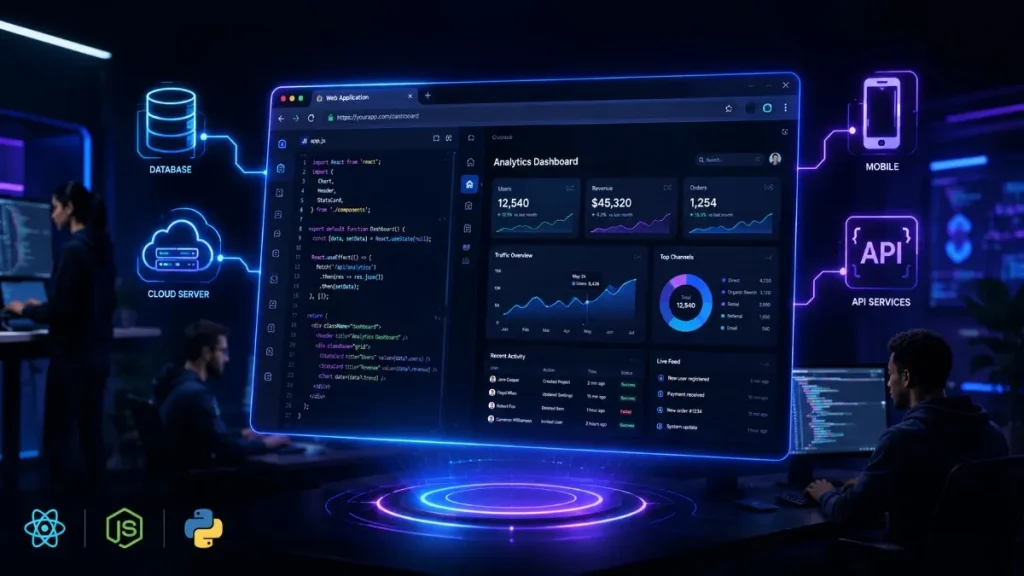
Web app architecture explained simply comes down to two sides that have to work together. The frontend is everything the user sees: the layout, the buttons, the forms, the visual feedback when something happens. The backend is everything happening behind that interface. Like the server processing requests, the database storing and retrieving information, and the logic deciding what the user is allowed to see or do.
A login screen is a good example. The frontend handles how the login form looks and what happens visually when you click submit. The backend checks your credentials against the database, decides whether they match, and tells the frontend what to show next. Neither side works without the other, and the quality of how they connect determines how fast and reliable the application feels.
Benefits of Web Application Development for Business
The advantages of web applications for business go well beyond just having a more functional website. A properly built web application becomes a genuine operational asset. It can automate work that currently takes manual effort, give customers self-service access to things they currently have to call or email for, and generate data that helps you make better decisions.
Why Businesses Need Web Applications to Stay Competitive
Web apps for business growth are not just about looking modern. They change how efficiently a business can operate. Here is what most businesses gain when they invest in the right web application:
- Customers can complete transactions, book services, or access their accounts without involving your team
- Internal processes that relied on spreadsheets or email chains get replaced with something that actually scales
- Data gets collected and organized automatically rather than manually
- The business becomes accessible around the clock without adding headcount
- Integration with other tools means information flows between systems without manual copying
Scalable ecommerce web application solutions also mean that when your business grows, the technology grows with it. A well-built web application does not need to be rebuilt every time you add users or expand into new markets. Digital transformation through web apps is not a buzzword. It is the practical outcome of replacing manual, fragmented processes with something centralized and automated.
Web Application vs Website: Understanding the Difference
The web application vs website difference comes down to interactivity and data. A website is primarily informational. It tells visitors who you are, what you do, and how to reach you. A web application is functional. It does something for the user and responds to what they do.
Web App vs Mobile App: Which One Do You Need?
This is one of the most common questions businesses ask when planning a digital product. The web app vs mobile app decision depends on your users and your use case. A web application runs in any browser on any device without requiring a download. A mobile app lives on the user’s device, can access hardware features like the camera or GPS, and works better in offline scenarios.
For many businesses, a web application is the right starting point because it reaches users on every device without the cost and complexity of building and maintaining separate apps for iOS and Android. If your use case later requires device-specific features or offline capability, a custom mobile app development project makes sense as a natural next step.
The question of which is better, a website or a web application, also comes up often. The honest answer is that they serve different purposes. If your goal is to inform visitors, a website works. If your goal is to let users do something, you need a web application. Asking if I need a web application for my business really comes down to whether your digital presence needs to be functional or just informational.
When comparing a web application vs a software application, the main distinction is delivery. Traditional software gets installed locally on a device. A web application is accessed through a browser and hosted remotely, which means updates happen centrally and users always have the latest version without doing anything.
Web Application Development Services: What Choosing the Right Partner Looks Like
Finding the right web application development services matters as much as deciding to build in the first place. A poorly executed application costs more to fix than it would have cost to build correctly from the start.
When you hire web application developers, the right team does not just write code. They ask questions about your users, your business logic, your growth plans, and your existing systems before they write a single line. They build things that can be maintained and extended, not just delivered and forgotten.
Businesses searching for an e-commerce web development company near me are often looking for accessibility and communication as much as technical skill. Being able to speak directly with the people building your product, get regular updates, and course-correct quickly is genuinely valuable. At Octet Solutions, that kind of collaborative process is the baseline. Whether the project is a lightweight internal tool or a full-scale enterprise web application development build, the approach starts with understanding the problem before proposing a solution.
Affordable web app development services mean scoped and built efficiently, so you are not paying for complexity you do not need. A good custom web application development company builds for your actual requirements, not a generic template of what a web application is supposed to look like.
The Future of Web Application Development
The future of web application development is being shaped by a few converging forces that are worth understanding, even if you are not a developer.
The future of progressive web apps is already here in many ways. PWAs are web applications that behave more like native mobile apps, loading instantly, working offline, and sending push notifications. They close the gap between a web app and a mobile experience without requiring a separate codebase.
Cloud-based web applications have become the default architecture for any serious application. Hosting on cloud infrastructure means better uptime, easier scaling, and more predictable costs than managing physical servers.
Modern web application trends also include AI automation and integration, and it is worth being clear-eyed about what that actually means in practice. AI in web application development today is less about replacing developers and more about adding capabilities to applications, things like intelligent search, automated data categorization, personalized recommendations, or conversational interfaces. These features were complex and expensive to build a few years ago. They are becoming standard.
Conclusion
Web application development is not a technical luxury. For businesses that want to operate efficiently, serve customers better, and grow without adding proportional overhead, it is a practical necessity. Understanding what a web application is, how the development process works, and what to look for in a development partner puts you in a position to make decisions that actually move your business forward.
If you are trying to figure out where to start, the answer is almost always the same: start with the problem you are trying to solve, not the technology. The right development partner will help you map the solution from there.
FAQs
What does web application development involve at a basic level?
Web application development means building software that runs in a browser and reacts when users interact with it. It starts with planning the idea, then moves into design, development, testing, and long-term updates.
How long does it take to develop a web application from scratch?
The timeline depends on how complex the project is. If we talk about a simple internal tool, it usually takes around 6 to 10 weeks. But a more advanced platform with user accounts, integrations, and a custom backend can take 6 months or longer.
What is the difference between a web application and a regular website?
A website mainly shows information, and every visitor sees more or less the same content. But a web application goes further. It lets users interact with it, store data, and get personalised results. For example, logging in, submitting forms, or managing accounts all fall under web applications.
How much do web application development services cost?
The cost depends on what you want to build. Hence, for smaller, clearly defined apps, the cost is less. But larger systems with many features, integrations, and custom workflows cost much more.
Do I need a custom web application, or will an off-the-shelf solution work?
Off-the-shelf tools work well when they already match your needs closely. You can use them quickly and avoid extra development work. But custom web applications make more sense when your business needs special features, unique workflows, or integrations that generic tools cannot handle properly.