
Every business now operates online, trying to stand out, trying to convert, and trying to grow. And somewhere in all those planning meetings and budget discussions, this question always shows up:
Mobile app development vs web development; which one actually makes sense for us?
It sounds simple. However, it’s often complicated to decide what to choose for your business.
Because when you really get into mobile app vs web app development services, the conversation stops being about “apps vs websites” and starts being about money, long-term growth, performance, and what your users actually want.
What Is Mobile Application Development?
Mobile application development is about building apps specifically for smartphones and tablets. You have to download them instead of opening them on Chrome.
There are different approaches:
Native App Development (iOS & Android)
Native app development means building specifically for one platform:
- iOS app development
- Android app development
This gives you top-tier speed, better security, smoother animations, and deeper integration with device features like GPS, camera, biometrics, and offline access.
Additionally, when people compare a native app vs web app, native usually wins on performance and user experience. But yes, it does cost more.
Hybrid & Cross-Platform Development
This is where hybrid app development and cross-platform development come in.
Instead of building two separate apps, developers use one codebase for both platforms. Tools like React Native or Flutter make this possible.
For businesses thinking about mobile app vs website development cost, this option often feels like a middle ground, better engagement than a website, and lower cost than fully native builds.
Why Businesses Prefer Mobile Apps?
When people talk about mobile app development benefits, they usually mean:
- Push notifications which is huge for engagement.
- They get to have personalized user experiences
- Better retention rates
- Stronger brand loyalty
- Access to app stores
- Higher long-term mobile app vs web app ROI
If your business depends on repeat users (e-commerce, fitness, fintech, delivery, etc.), mobile apps often drive stronger lifetime value.
However, that upfront investment is real. Which brings us to the other side.
What About Web Application Development?
Web application development is building something users access through a browser. No download required.
This includes:
- Standard websites
- Complex platforms
- SaaS dashboards
- E-commerce mobile apps for stores
It involves:
- Frontend development (what users see)
- Backend development (servers, logic, data)
- Often full-stack development (both combined)
Responsive Web Design & Progressive Web Apps (PWA)
With responsive web design, your website adapts to mobile, tablet, desktop, basically everything.
This means you have Progressive Web Apps (PWA). These blur the line. They behave almost like mobile apps but live in a browser. Faster loading. Offline support. App-like interface.
For businesses comparing mobile app vs web app for business, PWAs are often the “wait… this might actually work” option.
Web Development Benefits (That People Forget About)
When we look at web development benefits, they’re practical:
- Lower development cost
- Faster launch time
- No app store approvals
- Easier updates
- Strong SEO visibility
- Wider accessibility
If someone Googles your service, a web app shows up. A mobile app doesn’t.
That alone changes the mobile app vs web app comparison conversation.
Let’s Talk About Cost & Pricing
When we are comparing mobile app development vs web development, cost is usually what drives this decision.
With mobile application development, especially native app development for iOS app development and Android app development, you’re building separate platform experiences. That means more time, testing, and a heavier software development lifecycle, so the mobile app vs website development cost is typically higher.
With web application development, you build once, deploy through a browser, and update instantly. That’s why the cost of mobile app development vs website development usually favors the web.
In short:
- Mobile app has a higher upfront cost, but has potentially stronger long-term mobile app vs web app ROI.
- A web app has a lower initial investment, but launches faster.
Performance & User Experience
When discussing mobile vs web performance, native apps usually feel smoother. They’re built for the device.
Moreover, web apps have improved massively, especially with application performance optimization and PWAs, but they still rely on browsers.
From a UI/UX design perspective:
- Apps give you an immersive experience
- The web provides you with smooth access
And sometimes lower friction wins.
ROI
The big question: mobile app vs web app ROI.
Mobile apps often generate:
- Higher retention
- Stronger repeat engagement
- Better monetization model
Web apps often generate:
- Higher initial traffic
- Lower acquisition friction
- Faster market validation
Making the Right Choice: Mobile App vs Web Development
So you’ve decided between mobile app development vs web development, now comes the next step: finding the right team. Don’t stress about titles like web app development vs mobile app development company or mobile app development vs web development company. Just look for people who actually know what they’re doing:
- Real portfolio that shows what you’ve built, not just pretty mockups.
- They should have some industry know-how and should be familiar with your business, especially for e-commerce website development,
- Upfront pricing so you know your mobile app vs web development pricing.
- Plan for growth so your app or web project can scale with your business.
The difference between the two?
- Mobile apps (think native app development) live on devices, keep users hooked, and drive better engagement. It does have more cost upfront, but the mobile app vs web app ROI can be huge.
- Web apps (built with web application development using responsive web design or PWAs) are quick to launch, anyone can access them, and they help with SEO.
Ultimately, app development vs website development isn’t about labels. It’s about what your business needs, how you want people to use it, and what fits your budget and goals.
How to Decide Between the Two?
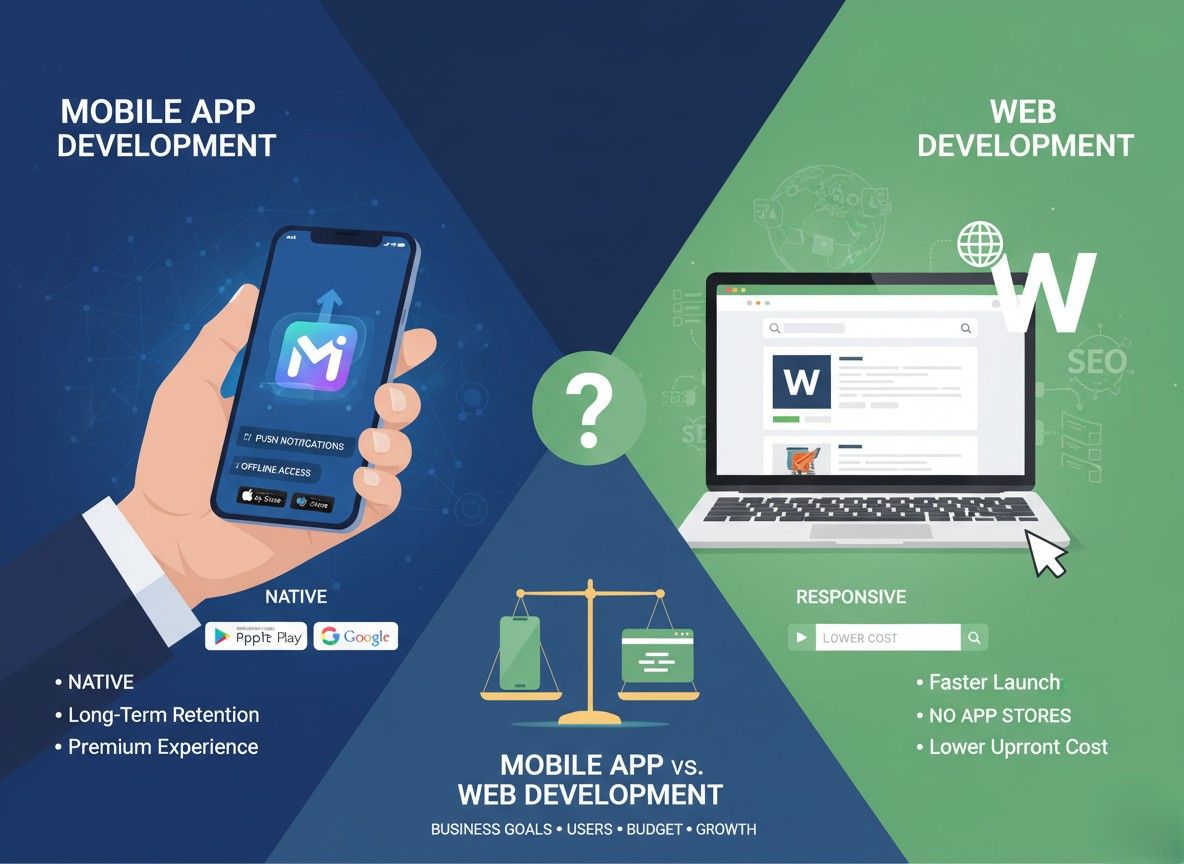
If your goal is:
- Deep engagement
- Long-term retention
- Premium experience
That means you should lean more toward mobile.
If your goal is:
- Accessibility
- Faster launch
- Lower upfront cost
Having these goals might make Web a smarter decision.
Some businesses even start with a web, validate the idea, then expand into mobile.
There’s no universal winner in the mobile app development vs web development discussion.
There’s only alignment with your business goals.
FAQs
1. How does platform dependency matter?
Mobile apps often need separate versions for iOS and Android, which is often more work and a bit costly. Web apps run anywhere, making them simpler to manage.
2. Which one is more cost-effective among mobile apps and web apps?
Native mobile apps cost more because of platform-specific coding and app store rules. Web apps are less costly and faster to launch.
3. Can a PWA replace a mobile app?
Sometimes. PWAs give a mobile-like experience without downloads.
4. Why should I consider a mobile app over a web application?
Mobile apps are a good option when you want deep integration with device features like camera, GPS, or notifications. They also let you create a more personal and engaging experience for users.
Conclusion
Overall, the whole mobile app vs web app comparison isn’t about tech superiority. It depends more on your strategy. Both have serious advantages, and both can deliver strong results when executed well. The real mistake that people do it that they choose based on trends instead of business logic. So, you should decide which one to go for after looking at your users, your budget, and your long-term roadmap.