What Is Software Development?
The Complete 2026 Guide for Beginners & Businesses
Key Takeaways
- Software development is the full process of designing, building, testing, and shipping digital products — not just writing code.
- The Software Development Life Cycle (SDLC) covers 6–8 phases, from initial planning all the way to ongoing maintenance.
- Agile, Scrum, Waterfall, and Lean are the most widely used methodologies — each suited to different project types.
- An MVP (Minimum Viable Product) lets startups get to market faster, with less risk and smarter use of resources.
Octet Solutions offers both custom software development services and professional training courses in Pakistan and globally.
What Is Software Development?
If you’ve ever used an app, browsed a website, or interacted with any digital tool — you’ve already experienced the result of software development. At its heart, it’s the complete process of taking an idea and turning it into a working digital product: from the first sketches on a whiteboard to the moment a real user opens it on their phone.
Software development covers everything — research, planning, design, coding, testing, deployment, and the ongoing work of keeping it running well. It’s not just for tech companies. In 2026, any business that wants to grow efficiently, serve customers better, or create new revenue streams needs to understand what software development is and how it works.
Software development is not just coding. It’s a full-lifecycle discipline — starting with a problem worth solving and ending with a product that delivers real value.
Why Does Software Development Matter in 2026?
Every industry runs on software now. Whether you’re in healthcare, retail, education, or finance — the businesses that invest in the right software are the ones pulling ahead. Here’s what good software development actually does for you:
- Automates the repetitive tasks your team shouldn’t be wasting time on
- Lets you scale your operations without having to hire proportionally
- Delivers experiences that keep your customers coming back
- Gives you real-time data so your decisions are based on facts, not guesses
- Opens up entirely new revenue streams through digital products and SaaS models
Software Development Life Cycle (SDLC)
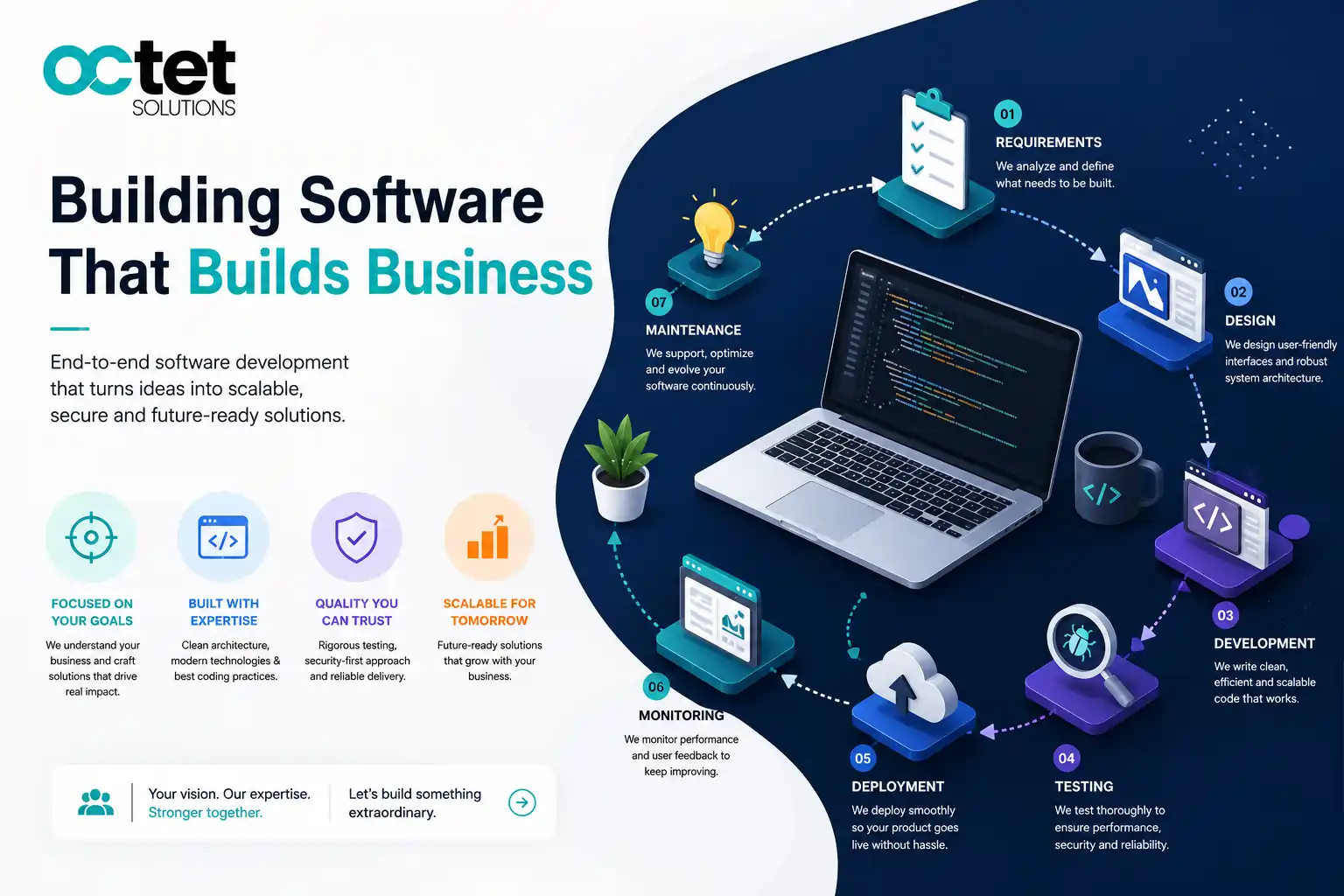
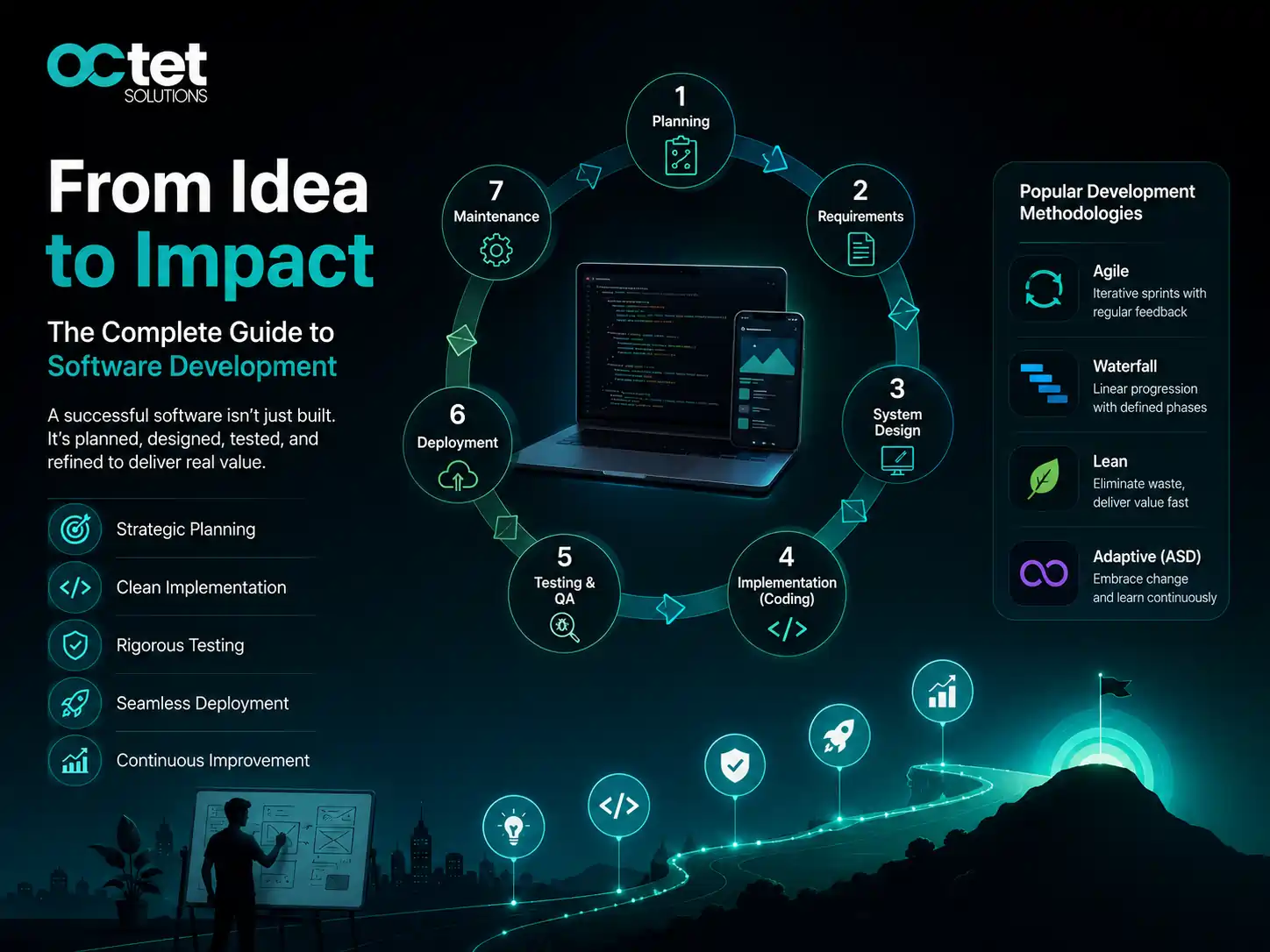
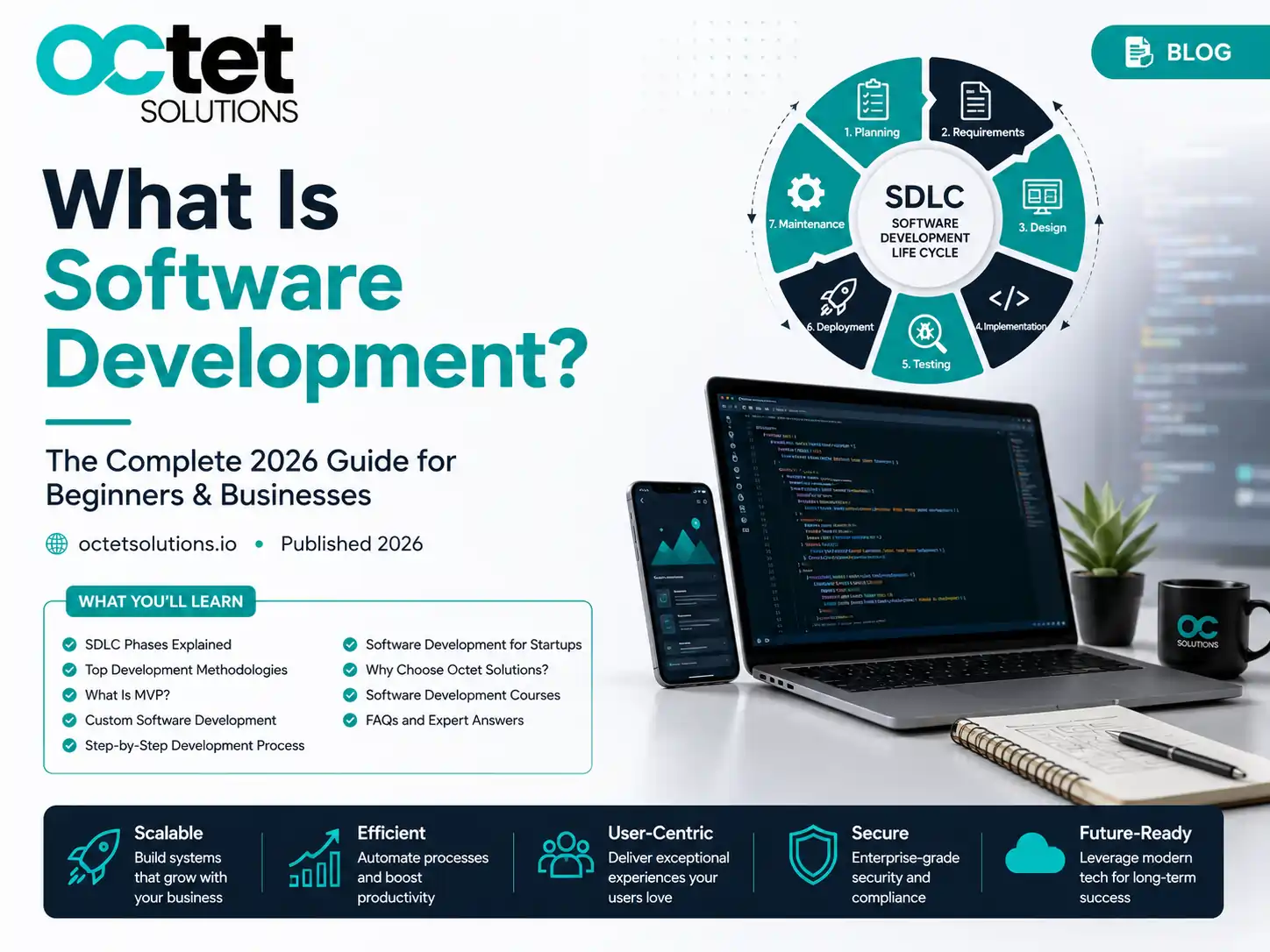
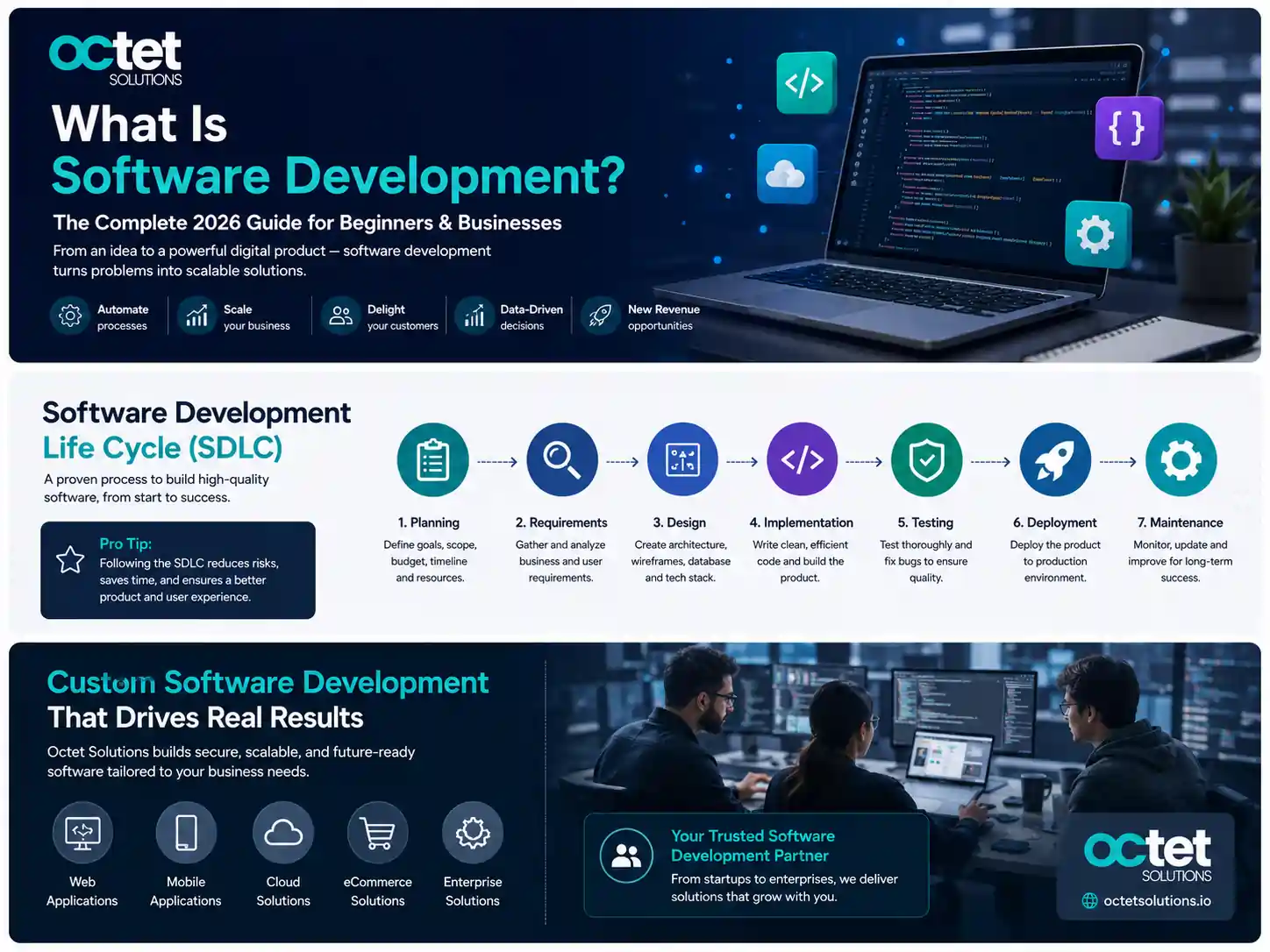
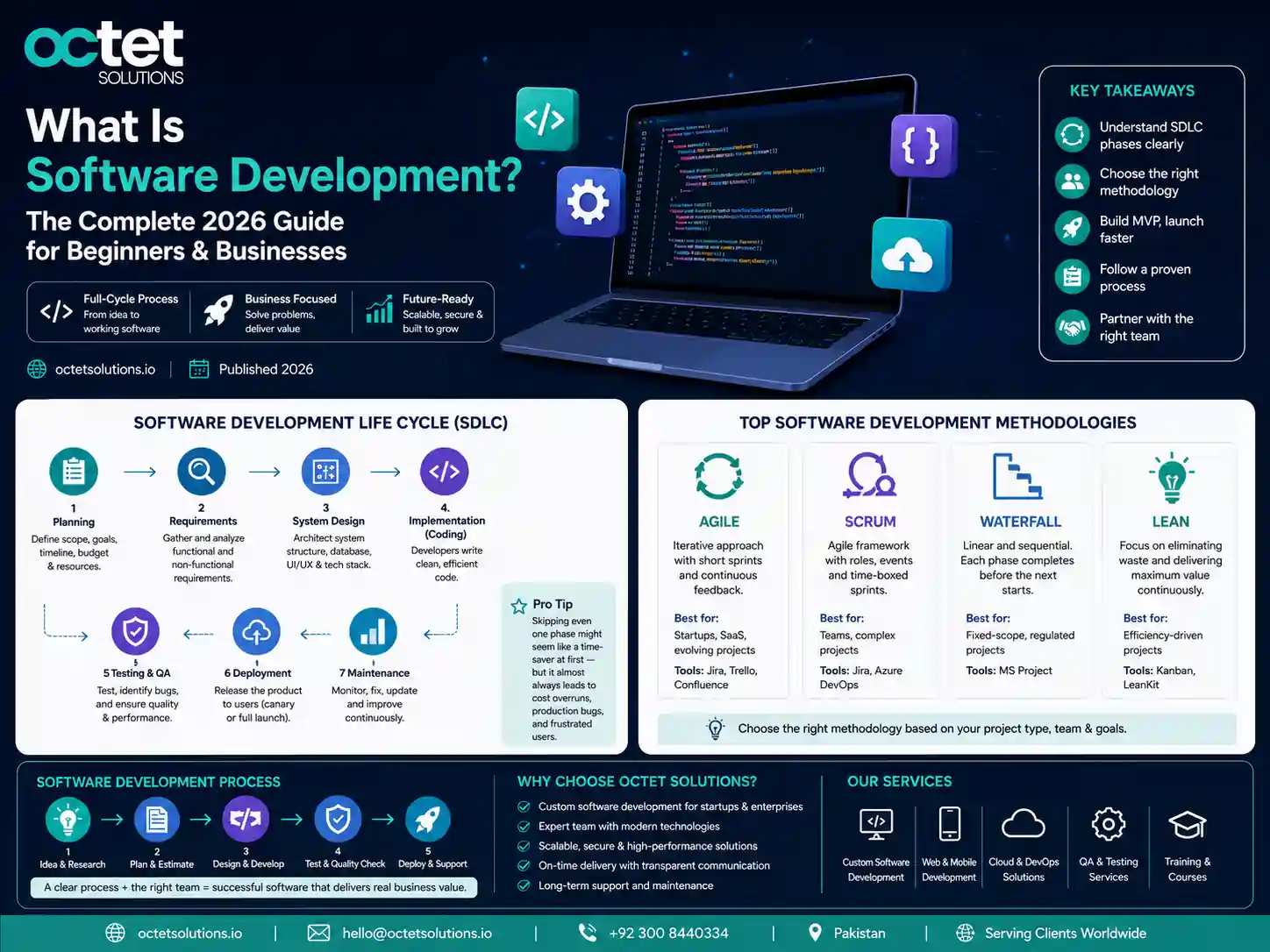
Every serious software project follows a structured path called the Software Development Life Cycle, or SDLC. Think of it as a roadmap — it stops teams from winging it and makes sure nothing critical gets skipped. Whether you’re building a simple mobile app or a complex enterprise system, the SDLC keeps the process organized, predictable, and far less stressful for everyone involved.
| SDLC Phase | What Actually Happens |
|---|---|
| Phase 1: Planning | Define scope, goals, timeline, budget, and resources. This is also where you identify and manage risks before they become problems. |
| Phase 2: Requirements | Have deep conversations with stakeholders to capture both functional needs (what the software does) and non-functional ones (how well it performs). |
| Phase 3: System Design | Architects decide on the system structure, database design, UI/UX wireframes, and the technology stack that will bring it all together. |
| Phase 4: Implementation (Coding) | Developers write the actual code, following the approved design. This is the construction phase — where the product starts taking shape. |
| Phase 5: Testing & QA | QA engineers run unit, integration, and system tests. Bugs get caught and fixed here, before any real users ever see them. |
| Phase 6: Deployment | The product goes live. This can be a gradual rollout (canary release) or a full launch, depending on the strategy. |
| Phase 7: Maintenance | Ongoing work — performance monitoring, bug patches, security updates, and adding new features as the product grows. |
Pro Tip: Skipping even one phase might seem like a time-saver at first — but it almost always leads to cost overruns, production bugs, and frustrated users. The full cycle exists for good reason.
Top Software Development Methodologies
The methodology you choose shapes how your team works day-to-day. It affects your timelines, your communication style, how you handle changes, and whether clients feel involved or kept in the dark. Choosing the right one early is one of the most important decisions a project makes.
Agile Software Development
Agile is the most popular approach in modern software development — and for good reason. Instead of planning everything upfront and delivering at the end, Agile breaks the work into short sprints (usually two weeks). Your team ships something working, gathers real feedback, and adjusts the plan accordingly. It’s honest, flexible, and far less likely to produce something nobody wanted.
- Best for: Startups, SaaS products, teams with evolving or unclear requirements
- Common tools: Jira, Trello, Confluence
- Core idea: Working software matters more than perfect documentation
Waterfall Model
Waterfall is the old-school approach — linear, structured, and sequential. Each phase must be fully completed before the next begins. It sounds rigid (because it is), but that rigidity is actually useful when you know exactly what you’re building and requirements are unlikely to change.
- Best for: Government projects, construction management software, fixed-scope contracts
- Honest trade-off: Changes mid-project are expensive and slow — plan carefully upfront
Lean Software Development
Lean was inspired by Toyota’s manufacturing philosophy, and it translates surprisingly well to software. The focus is simple: eliminate anything that doesn’t directly serve the user, build quality in from the start, and keep improving based on what you learn.
- Cut everything that doesn’t add real value to the end user
- Don’t test quality in at the end — build it in from the beginning
- Ship fast, learn from real feedback, and iterate
Adaptive Software Development (ASD)
Adaptive development accepts that requirements will change — and builds that assumption into the process. Rather than treating uncertainty as a problem, ASD treats it as the normal state of building complex software.
- Best for: High-uncertainty projects where requirements are genuinely unknown upfront
- Three core phases: Speculate (plan loosely), Collaborate (work together), Learn (reflect and improve)
| Methodology | Key Characteristic | Best Suited For |
|---|---|---|
| Agile | Iterative sprints with regular feedback loops | Startups, SaaS, evolving products |
| Waterfall | Linear phase-by-phase progression | Fixed-scope enterprise projects |
| Lean | Waste elimination and fast delivery | Efficiency-focused, resource-conscious teams |
| Adaptive (ASD) | Embraces change and uncertainty by design | Complex, high-uncertainty projects |
| Scrum | Agile framework with defined roles and ceremonies | Cross-functional product teams |
What Is MVP in Software Development?
MVP stands for Minimum Viable Product. It’s the leanest, most focused version of your product that still delivers real value to early users — and more importantly, gives you the data you need to decide what to build next.
The whole point of an MVP isn’t to build something perfect. It’s to build just enough to test your core idea with real people, before you invest months or years into a full product. The faster you can put something in front of real users, the sooner you learn what actually matters to them.
Think of the MVP as the first chapter of your product’s story — not the whole book. Founders who skip it often spend months building features nobody asked for.
Why MVPs Are Critical for Startups
- Cuts time-to-market from 12 months down to 6–8 weeks in many cases
- Lets you validate product-market fit before committing serious budget
- Attracts early adopters and gives investors something real to look at
- Dramatically reduces financial risk — you’re testing a bet, not all-in on one
- Real user feedback shapes your full product roadmap, not assumptions
MVP in Action — A Real Example
When Dropbox launched, they didn’t have a finished product. They published a simple demo video explaining what the product would do. That video alone generated 75,000 signups overnight — validating massive demand before a single line of backend code existed.
At Octet Solutions, we help startups plan and build exactly this kind of lean, focused MVP. Our custom software development services cover everything from architecture decisions to the final launch — designed to get you to market fast and smart.
Types of Custom Software Development
Off-the-shelf tools like Shopify or Salesforce are great starting points, but they come with a ceiling. Custom software development means building something made specifically for your business — your workflows, your users, your rules. You own it, you control it, and it can scale exactly how you need it to.
- Web Application Development — browser-based platforms, SaaS products, and custom portals
- Mobile App Development — native iOS and Android apps for consumers or enterprise teams
- Enterprise Software Development — large-scale systems like ERPs, CRMs, and HRM platforms
- API & Integration Development — connecting your systems with each other and with third-party services
- E-Commerce Platforms — fully custom online stores with tailored checkout, inventory, and logistics flows
- AI & Automation Tools — chatbots, recommendation engines, and intelligent process automation
Custom software development cost depends heavily on complexity, team size, and how quickly you need it. A basic web app might start at a few thousand dollars. Enterprise-grade platforms can reach six or seven figures. Getting a proper scoping session done upfront is the best way to understand what you’re actually investing in.
Octet Solutions is a custom software development company based in Pakistan, serving clients in the USA, Dubai, UK, and beyond. We build scalable, cost-effective digital products for startups and growing enterprises.
Software Development Process — Step by Step
Whether you’re a developer or a business owner, understanding how the software development process actually unfolds helps everyone work together more effectively. Here’s how a well-run project moves from idea to live product:
- Discovery & Requirements — Understand the real problem, define the features, and make sure every stakeholder is aligned before any work begins.
- Architecture & Planning — Choose the right tech stack, design the system architecture, and build a realistic project roadmap.
- UI/UX Design — Create wireframes and high-fidelity mockups. Get sign-off on how things look and feel before a single line of code gets written.
- Frontend Development — Build everything users see and interact with — the screens, buttons, animations, and flows.
- Backend Development — Build the server logic, databases, APIs, and all the business rules that power the product behind the scenes.
- Integration & Testing — Connect all the components together, run thorough QA, fix every bug, and confirm the product does what it’s supposed to.
- Deployment & Launch — Release to production on cloud infrastructure (AWS, Azure, or GCP) and make it available to real users.
- Post-Launch Support — Monitor performance, respond to issues, and keep shipping improvements based on real user feedback.
This is the same process followed by every reputable software development firm — whether they’re based in Pakistan, the USA, or Dubai. The fundamentals don’t change.
Software Development for Startup
Building software for a startup is a different challenge entirely. You’re working with limited budgets, tight timelines, and a lot of unknowns. The last thing you need is a slow, expensive agency that treats your project like a factory job. What startups need is a technical partner who moves fast, thinks strategically, and actually cares whether the product succeeds.
What Startups Actually Need from a Development Partner
- An MVP in the market in 6–10 weeks — not six months
- Architecture that can scale as the product grows, without a full rebuild
- Agile delivery with weekly updates — no black holes, no surprises
- Strategic thinking — not just code execution, but genuine product thinking
- Post-launch support and iteration guided by real user data
Octet Solutions has worked alongside early-stage startups from the first idea all the way to launch and beyond. We don’t think of ourselves as a vendor — we show up as a technical co-founder. Because for a startup, the software isn’t just a tool. It is the business.
Whether you’re raising your first round or scaling post-launch, Octet Solutions builds software that investors trust and users actually want to keep using.
Why Choose Octet Solutions?
Your Software Development Partner
Octet Solutions is a software development company based in Lahore, Pakistan, trusted by clients from the USA, Dubai, UK, and beyond. We’re not a generic agency. We bring deep technical expertise, a genuine client-first mindset, and the kind of accountability that makes projects actually succeed.
| What We Offer | What You Actually Get |
|---|---|
| Custom Software Development | Fully tailored web and mobile solutions built around your specific business needs and growth goals. |
| MVP Development | Get to market in weeks, not months. Test your idea fast, learn what works, then build with confidence. |
| Enterprise Software | Scalable, robust systems for growing organizations — ERP, CRM, HRM, and beyond. |
| Software Development Courses | Hands-on training programs to build your team’s skills or launch your own development career. |
| Outsource Software Development | Cut costs by up to 60% without cutting corners. Remote-first, reliable, and transparent. |
| Web Development (Lahore & Remote) | A trusted software house in Lahore serving clients locally and globally. |
Octet Solutions — By the Numbers
- Headquartered in Lahore, Pakistan — one of South Asia’s fastest-growing tech cities
- Active clients in the USA, UK, UAE/Dubai, Canada, and Australia
- Full-stack capabilities: React, Node.js, Python, Flutter, Laravel, and more
- 100% custom builds — we don’t do templates or shortcuts
- Agile delivery with transparent weekly sprints — you always know where things stand
Looking for a reliable software development agency to outsource to? Octet Solutions delivers the quality you’d expect from a Silicon Valley team, at a price point that makes sense for where your business is today.
Software Development Courses at Octet Solution
Building great software isn’t just what we do for clients — it’s what we teach. Octet Solutions runs professional development courses for students, career changers, and working professionals who want to break into tech or level up their skills. Our instructors don’t just teach theory. They build real products, and they bring that real-world experience into the classroom.
What You’ll Learn
- Programming foundations — Python, JavaScript, and core web technologies
- Frontend development — HTML, CSS, React.js, and responsive design principles
- Backend development — Node.js, SQL & NoSQL databases, and API design
- Mobile development — Flutter for building iOS and Android apps
- Software methodologies — Agile, Scrum, Git version control, and team workflows
- Real-world projects and a portfolio that actually shows what you can do
- Career support — resume writing, LinkedIn, interview prep, and freelancing basics
Our curriculum follows an industry-aligned roadmap — the same one used at top tech companies globally. Whether your goal is landing a job, building a freelance career, or launching your own startup, we prepare you for the real thing.
Enroll today at octetolutions.io and start your journey with mentors who actually build products for a living — not just teach from a textbook.
Frequently Asked Questions
Straight Answers to Real Questions
| Q: What is software development? |
| Software development is the full process of designing, coding, testing, and deploying digital products. It covers everything from the app on your phone to the enterprise system your company runs. The process follows the SDLC — planning, design, development, testing, deployment, and ongoing maintenance. |
| Q: What are real examples of software development? |
| Every digital product you use is the result of software development: e-commerce sites, mobile banking apps, hospital management systems, ride-sharing platforms like Uber, SaaS accounting tools, even simple productivity apps. If it runs on a device, someone built it through a software development process. |
| Q: What is software development actually used for? |
| It’s used to automate business processes, build customer-facing applications, manage and analyze data, power AI systems, enable digital communication, and create scalable products. In 2026, nearly every industry depends on custom software to function efficiently and stay competitive. |
| Q: How does software development actually work? |
| It starts by defining the problem clearly, then moves through design, development, testing, and deployment — with real users in mind at every step. Agile teams break this into two-week sprints with regular feedback from clients, so the product evolves based on what’s actually working. |
| Q: What software development courses are available at Octet Solutions? |
| Octet Solutions offers professional programs covering web development, mobile development, backend engineering, and full-stack development. Every course is project-based, career-focused, and built around industry best practices. Visit octetolutions.io to see current course offerings and enrollment options. |
| Q: How do I start a software development career? |
| Start with a language you can actually use — Python or JavaScript are both excellent entry points. Learn core concepts like data structures, object-oriented programming, and algorithms. Build real projects. Then invest in structured learning to accelerate your progress. A course like those at Octet Solutions gets you from zero to job-ready much faster than self-study alone. |
Conclusion
Software development is one of the most valuable skills and disciplines of our time — and understanding it puts you ahead, whether you’re running a business, leading a startup, or building a career in tech.
What you build matters. How you build it matters just as much. The right process, the right methodology, and the right partner make the difference between a product that takes off and one that never gets off the ground.
Octet Solutions is here as your software development agency, your custom software development company, and your development training institute. We don’t just write code. We help you think through problems, make smart decisions, and ship products that people actually use.
Ready to build your next software product — or start your development career? Visit octetolutions.io or reach out today. Let’s build something worth using.