
The software development process is what separates a product that launches on time from one that drains your budget and never ships. If you’re a business owner trying to understand what your development team is actually doing (or should be doing), this guide is for you.
We’ll break it down into steps and talk about why agile works so well for small businesses, and walk you through exactly how we do things at Octet Solutions so you know what to expect when you work with us.
Key Takeaways
- The software development process is what determines whether a project ships on time, stays within budget, and actually solves the problem it was built to solve. It is not just a technical formality.
- The SDLC gives every project a clear sequence to follow: planning, requirements, design, development, testing, and deployment.
- Agile works better than waterfall for most small businesses because it keeps you in the loop throughout the process.
- Sprints are short cycles, usually two weeks, where the team builds, tests, and reviews a defined set of features. They keep feedback loops tight and make sure problems surface while they are still easy to fix.
- Discovery and requirement gathering is the phase most teams undervalue, and most projects suffer from. You need to clearly define what you’re building before the development.
- Timelines are different, like an MVP takes 6 to 12 weeks, a web app takes 3 to 6 months, and a custom mobile app takes 4 to 8 months.
What Is the Software Development Life Cycle (SDLC)?
The software development life cycle (SDLC) is the structured framework that guides how software gets built from your first idea all the way to launch and beyond. It’s a way of thinking about development in organized, repeatable stages.
Think of it like building a house. You wouldn’t pour the foundation without blueprints. You wouldn’t start interior work before the walls are up. Software is the same; it needs a sequence, and that sequence is the SDLC.
Every serious development team follows some version of it, whether they call it that or not.
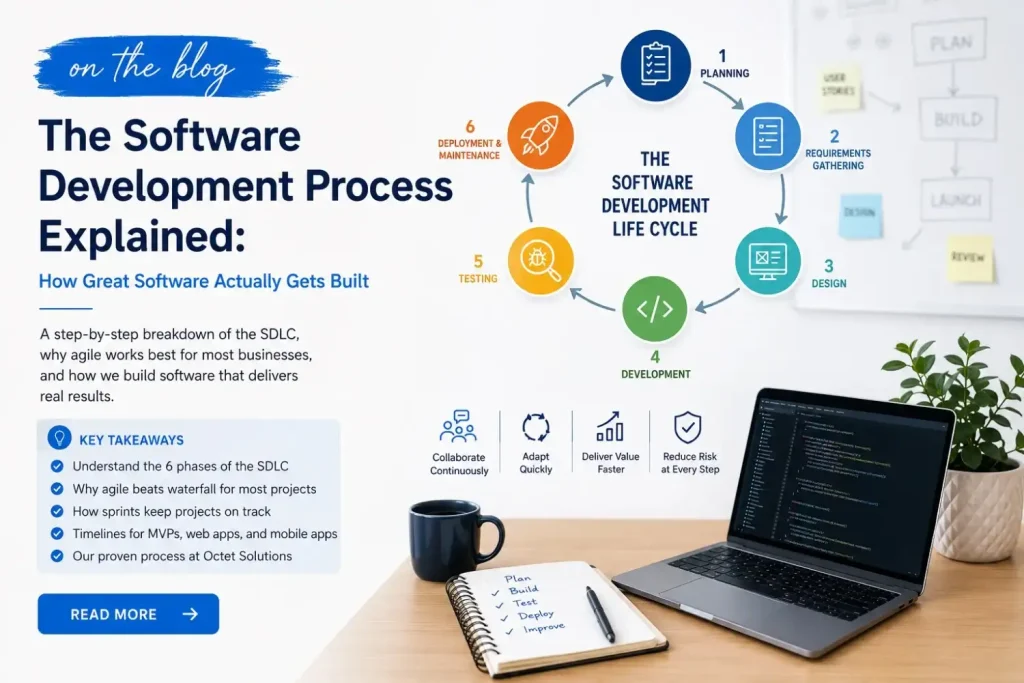
What are the 6 Phases of the SDLC
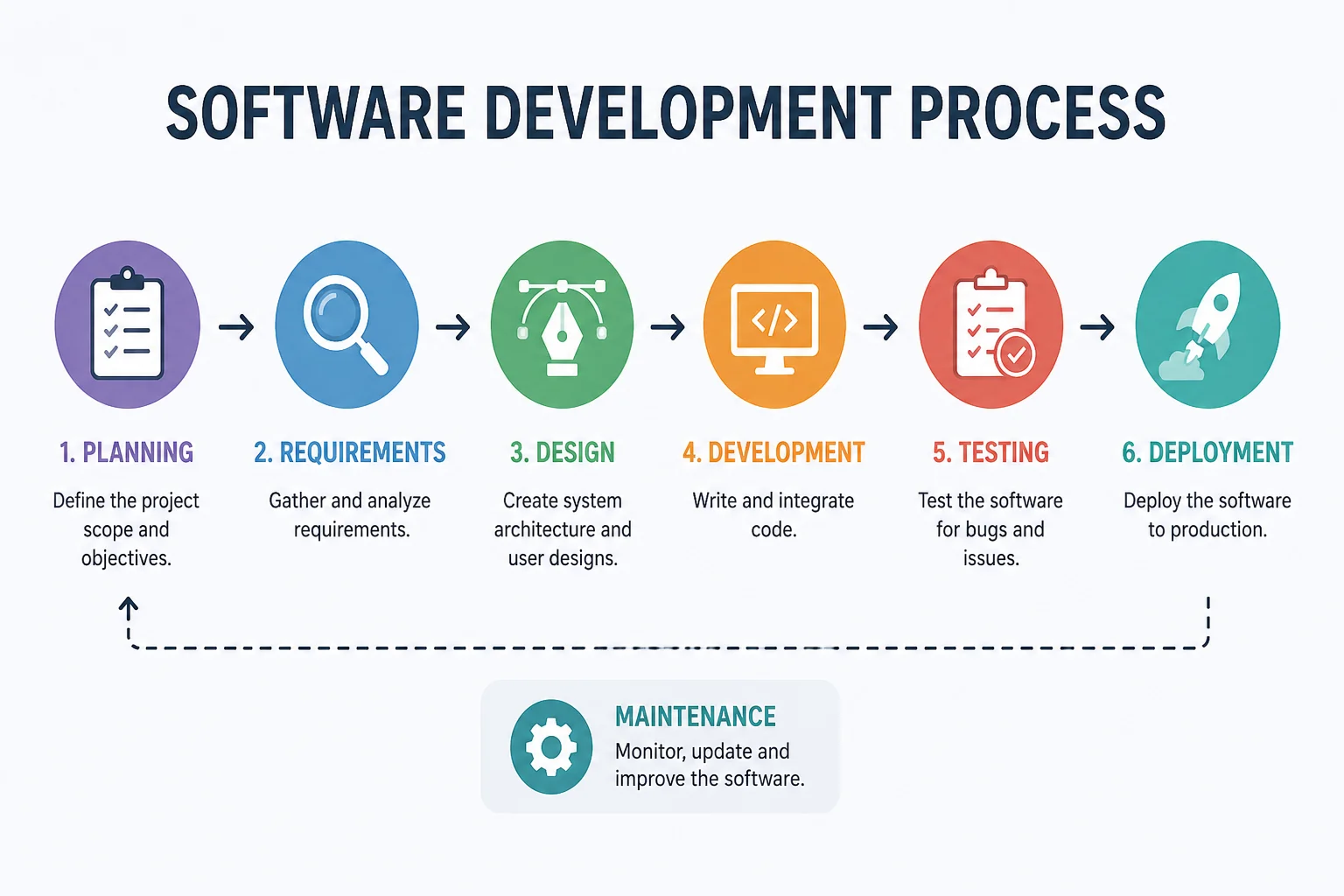
Here’s how the custom software development life cycle typically breaks down:
- Planning: Define the scope, estimate cost, and assess feasibility. What are we building and why?
- Requirements Gathering is where you figure out what the software needs to be doing from a business and a user perspective.
- Design is when we create the blueprint. System architecture, database setup, wireframes, user flows, everything gets mapped out so the developers know exactly how all the pieces should fit together.
- Development is the coding phase. Frontend, backend, APIs, integrations, this is where it all starts coming to life.
- Testing makes sure it actually works. We run unit tests, integration tests, performance checks, and real user testing to catch problems before they reach you.
- Deployment and maintenance are when the product finally goes live. After that, it’s ongoing bug fixes, monitoring, and updates.
Some projects compress a few of these. Some run them in loops. But every good software development process covers all six in some form.
Waterfall vs Agile Development: Which Is Better?
This is one of the most common questions we hear. Here’s the honest answer: it depends on your project.
Waterfall moves in a straight line. You finish planning before design, design before development, and so on. It’s predictable, well-documented, and works well when requirements are locked in from day one, like building compliance software with highly specific regulations.
Agile works in cycles. You build a little, test a little, get feedback, adjust, and repeat. It’s flexible, fast, and far better suited to most modern projects where requirements evolve.
For most small businesses and startups, agile wins. Here’s why: your requirements will change. Your users will surprise you. Agile is built for that reality.
Agile Software Development Process for Small Businesses
Agile software development for small businesses is really about one thing: building the right product without wasting money on the wrong one.
When you’re working with a limited budget, you can’t afford to spend six months building something, only to find out users wanted something different. So instead, you build in small steps, check in often, and adjust as you go.
What Is a Sprint and How Does It Work?
A sprint is basically a short burst of work in software development, usually about 1-4 weeks.
Instead of trying to build everything all at once, the team just zooms in on a small set of things, gets them done, and ends the cycle with something that actually works and can be tested.
It usually goes like this:
- Sprint Planning: The team sits down, looks at everything that needs to be done, and agrees on what can realistically be finished in the next couple of weeks.
- Daily Standups: Then they do a quick daily check-in where everyone says what they did, what they’re doing next, and what’s blocking them.
- Development & Testing: Now this is the actual build phase. Work moves in small pieces, and testing happens at the same time, so issues don’t pile up later.
- Sprint Review: At the end, the team shows what they’ve built and gets feedback from the people involved.
- Retrospective: Then they just reflect on the sprint, what went smoothly, what didn’t, and what to tweak next time.
For business owners, it’s a lot less abstract than it sounds. You’re not waiting months to see progress. You’re seeing working updates every few weeks, giving feedback as you go, and adjusting before things drift off track.
How Agile Reduces Risk and Speeds Up Delivery
Traditional development bets everything on the final reveal. If something’s wrong, you find out late, and late fixes are expensive.
Agile catches problems early, when they’re cheap to fix. Each sprint is a small experiment. If a feature isn’t landing right, you adjust in the next cycle. If a requirement changes (and it will), you fold it in without derailing the whole project.
The result is faster delivery, lower risk, and a product that actually matches what your users need, not just what you imagined six months ago.
Our Software Development Process at Octet Solutions
We’ve built products across industries from HR platforms to VoIP systems, and every one of them has gone through the same core process. Here’s how the software development process actually works when you partner with us.
Phase 1: Discovery and Requirement Gathering
Before a single line of code gets written, we sit down with you to understand the problem you’re solving. Not just the features you want, but the why behind them.
This phase includes:
- Stakeholder interviews and goal alignment
- Competitive landscape review
- Technical feasibility assessment
- Requirement documentation (user stories, functional specs)
Most teams skip this. We don’t. A solid discovery phase is what keeps projects from going off the rails mid-build.
Phase 2: UI/UX Design and Prototyping
Once we know what we’re building, we look at how ux/ui design should look and feel before development starts. This means wireframes, user flows, and clickable prototypes you can actually test.
Why does this matter? Because it’s a lot cheaper to change a design mockup than rewrite code. Getting feedback on a prototype early means the final product feels intuitive from day one.
Phase 3: Development and Testing
This is where the actual software development process steps happen in earnest. Our dev team works in agile sprints, building features incrementally while QA runs in parallel.
We don’t wait until the test ends. Every sprint includes:
- Unit and integration testing
- Cross-device and cross-browser checks
- Performance testing under real load conditions
- Bug tracking and resolution cycles
By the time we reach launch, the product has already been tested extensively.
Phase 4: Launch and Post-Launch Support
Going live is a milestone, not the finish line. After launch, our team stays on to monitor performance, fix anything that surfaces in production, and help you scale as your user base grows.
We also provide documentation and knowledge transfer so your internal team isn’t left in the dark after handoff.
How Long Does Software Development Take?
This is the question everyone asks, and the honest answer is: it depends. But “it depends” isn’t useful on its own, so here’s a practical breakdown.
MVP (Minimum Viable Product)
An MVP is the most basic version of your product that people can actually use and test. It’s usually the first step when you want to see if your idea works before building everything else, so a typical timeline is 6-12 weeks
This usually includes only the main features, a simple UI, and enough functionality to get real feedback. However, adding extra features midway is one of the biggest reasons timelines get delayed.
Web Application
A custom web development usually takes more time, like around 3-6 months, since there’s more happening behind the scenes, like user accounts, dashboards, databases, and integrations.
The timeline depends on how complex the app is, how many features it needs, and if you’re building the design from scratch.
Mobile App
Mobile app development usually takes longer because you often need to support both iOS and Android.
For most apps, expect 4-8 months. Simple apps can be done quicker, but once you add stuff like push notifications, real-time updates, or offline mode, it adds time. Using Flutter App development or React Native can definitely speed things up by letting you build for both platforms with one codebase.
A few things that affect every timeline:
- How quickly can stakeholders provide feedback
- Whether design is done before or during development
- The complexity of third-party integrations
- How well requirements are defined upfront
Conclusion
Whether you’re building your first product or scaling an existing one, a structured, agile software development process is what turns ideas into software that actually works.
At Octet Solutions, we combine the discipline of a proven process with the flexibility to adapt as your project evolves. From discovery to deployment and everything in between, we’re your development partner, not just a vendor.
FAQs
What is the software development process in simple terms?
It’s a way in which teams turn an idea into real software planning, building, testing, and launching it properly. A good process keeps things from going off the rails.
Which software development methodology is best for a small business?
Agile is more flexible, you see progress quickly, and you can easily change direction when needed. Perfect for small teams.
What are the main software development process steps?
Discovery, planning, design, development, testing, deployment, and then ongoing maintenance.
How long does software development take for a startup?
MVP usually takes 6-10 weeks. A fuller product is more like 3-6 months, depending on complexity.
Can I change requirements mid-project?
Yes, especially with Agile. That’s what it’s made for. Just expect small timeline tweaks if you change things often.