
Software development for startups is what helps make the right decisions at the right time, especially when you’re working with a limited budget, a small team, and a product that nobody has seen yet. That pressure is real, and most early-stage founders feel it every single day.
This guide is for founders who are past the “I have an idea” stage and are now asking the harder question: how do I actually build this?
Key Takeaways
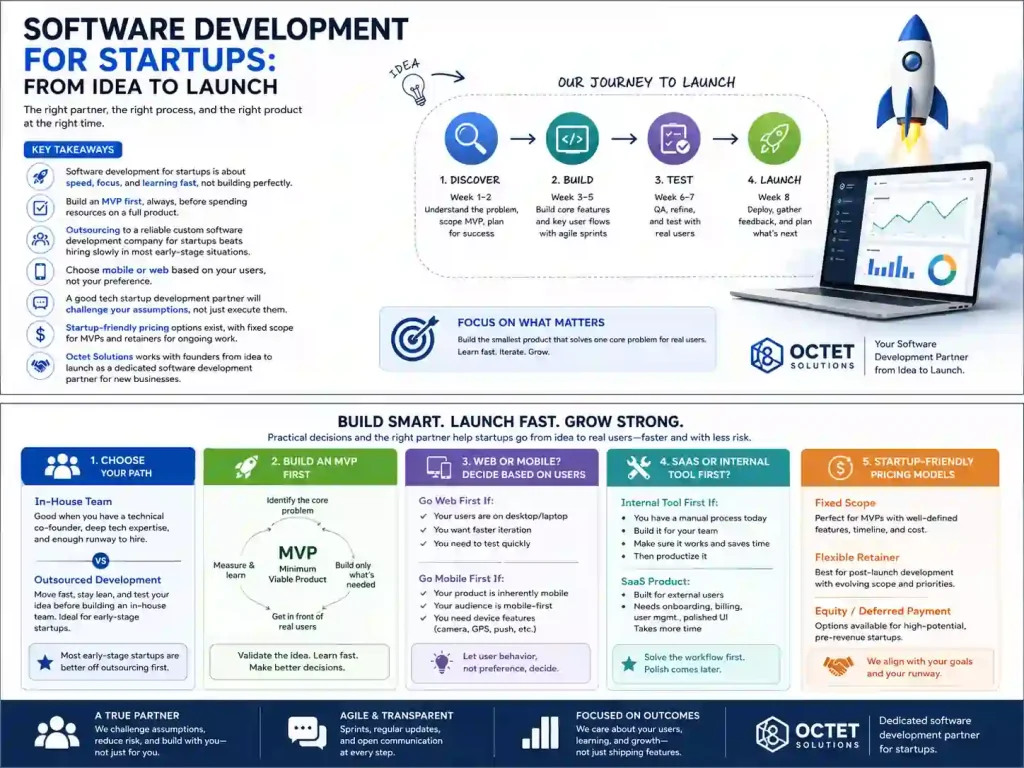
- Software development for startups is about speed, focus, and learning fast, not building perfectly.
- Build an MVP first, always, before spending resources on a full product.
- Outsourcing to a reliable custom software development company for startups beats hiring slowly in most early-stage situations.
- Choose mobile or web based on your users, not your preference.
- A good tech startup development partner will challenge your assumptions, not just execute them.
- Startup-friendly pricing options exist, with fixed scope for MVPs and retainers for ongoing work.
- Octet Solutions works with founders from idea to launch as a dedicated software development partner for new businesses.
Why Startups Need a Dedicated Software Development Company
Most startups do not have a CTO on day one. And even those that do often find that one technical person cannot handle strategy, architecture, hiring, and delivery all at once.
That is where a proper software development company for startups comes in. A team that has done this before understands what early-stage products need and can move fast without making a mess.
In-House Team vs Outsourced Development for Startups
This is one of the first decisions founders agonize over. Here is how to actually think about it.
Building in-house makes sense when:
- You have found a strong technical co-founder willing to work at equity or a low salary
- Your product is deeply technical and requires specialized knowledge that is core to your IP
- You are well-funded and can afford the time to hire, onboard, and manage a team
Outsourcing makes more sense when:
- You need to move fast and cannot wait three months to hire
- You want to test your idea before committing to a full team
- Your runway is limited, and you need to be lean
The honest truth? Most early-stage startups are better off outsourcing to an experienced team and then gradually building in-house as the product matures.
How a Development Partner Reduces Startup Risk
A good tech startup development partner does not just build what you ask for. They push back when something does not make sense and flag the scope creep before it kills your timeline. Then they help you decide what to build first and what to skip entirely.
That kind of judgment is hard to put a price on, especially when every wrong decision costs you weeks and money you do not have.
MVP Software Development for Startups
Before you build the full product, you need to build something smaller. And it needs to be something that proves the idea works without spending everything you have.
What Is an MVP and Why You Should Build One First
An MVP, or Minimum Viable Product, is the most stripped-down version of your product that still delivers real value to real users. Not a prototype. Not a mockup. An actual working thing.
The point is not to build something ugly. The point is to build something focused. Every feature you skip in the MVP is a feature you do not have to rebuild after you learn what users actually want.
Good MVP software development services focus on:
- Identifying the one core problem your product solves
- Then, build only what is needed to solve that problem
- Also, getting it in front of real users as fast as possible
- And measuring what happens and using that to make the next decision
How to Build an MVP in 8 Weeks with Agile Development
Eight weeks sounds short. For a focused MVP, it is actually very doable.
Here is roughly how that breaks down:
- Week 1-2: Discovery and planning: Scope the MVP features, define the tech stack, set up the development environment, and agree on what success looks like.
- Week 3-5: Core development: Build the main user flows. Not everything, just the flow that delivers the core value. Backend, frontend, basic integrations.
- Week 6-7: Testing and refinement: QA, bug fixing, performance checks, user testing with a small group if possible.
- Week 8: Launch and feedback: Deploy, monitor, gather feedback, and start planning what comes next.
This only works with a clear scope and agile sprints. If you keep changing requirements mid-build, eight weeks becomes sixteen.
What Software Does Your Startup Actually Need?
This sounds obvious, but most founders get it wrong. They imagine the full product before they have validated the core idea. Then they spend six months building something users do not want.
Step back. What is the single thing your product needs to do to be useful on day one?
Should I Build a Mobile App or Website for My Business?
A startup app development company will help you make this call based on user behavior instead of assumptions.
So, go with a web application development first if:
- Your users are likely on desktop or laptop (B2B tools, dashboards, admin-heavy products)
- Or you want faster iteration cycles (web deploys are instant, app store updates are not)
- Or if you need to test quickly before committing to platform-specific development
And choose the mobile app development first if:
- Your product is inherently mobile (delivery, location-based, on-the-go use cases)
- Or your target audience skews heavily mobile
- And if the experiences genuinely require device features like camera, GPS, or push notifications
SaaS Product vs Custom Internal Tool: Which to Build First?
If you are selling software to other businesses, this question comes up a lot.
A SaaS product is built for external users. It needs onboarding, billing, user management, a polished UI, and documentation. It takes longer.
A custom internal tool is built for your own team. Instead of looking pretty, it should work properly and save time.
If your startup depends on a manual process right now, build the internal tool first. Use it yourself, and make sure the customised technology and process actually work. Then think about productizing it for others.
Trying to build a polished SaaS from day one, before you have validated the workflow, is how startups waste months.
How Octet Solutions Works with Startups
At Octet Solutions, we have worked with enough early-stage founders to know what the process actually looks like up close. It is rarely clean. Priorities shift. Budgets tighten. Scope changes. Users say unexpected things.
We work with startups as a real software development partner for new businesses, not just a vendor who disappears after handoff. That means being in the conversation from discovery through launch, and beyond if needed.
Our Startup Process from First Call to First Launch
When a startup comes to us, the first thing we do is not to waste time, but to understand the problem properly before touching any code.
We ask:
- What does your user actually need to do?
- Then, what is the riskiest assumption in your product idea?
- And what would make this MVP a success in 8 weeks?
From there, we scope, plan, and build in sprints. Every sprint delivers something real, without any long wait or surprises later on.
What Makes Us a Good Fit for Early-Stage Startups
We are not the right fit for every startup. We are probably the right fit if:
- You have a validated idea, but need a team to build it
- Or if you want MVP software development services that focus on speed and learning, not perfection
- When you need a startup app development company that treats your product like its own
- And when you value honest feedback over yes-men
We are not the right fit if you want to hand over a 200-page spec and hear nothing for three months. That is not how a good software development process goes and how it gets built.
Startup-Friendly Pricing and Engagement Models
Software development for startups should not require a massive upfront commitment. Most founders are not flush with capital, and any good partner should understand that.
Fixed Scope vs Flexible Retainer
Fixed scope works when you know exactly what you are building. You agree on features, timeline, and software development cost upfront. Good for MVPs where the scope is tight and well-defined.
Flexible retainer works better for ongoing development after MVP launch. You get a dedicated team for a set number of hours per month. Scope can shift as you learn from users.
Equity and Deferred Payment Models
Some software houses, including agencies focused on startup app development, offer arrangements where part of their fee is deferred or taken as equity. This is not common and comes with risks on both sides, but it does exist for founders who are pre-revenue and high-potential.
This is worth exploring if you have a strong track record or are part of an accelerator program.
FAQs
What is software development for startups, and how is it different?
Software development for startups moves a lot faster than traditional enterprise development. Instead of spending months perfecting every feature, the focus is usually on testing ideas quickly, learning from users, and improving as the product grows.
How much does MVP software development cost?
MVP costs can vary depending on the features, complexity, and timeline. In most cases, a simple MVP built within 6 to 10 weeks can cost anywhere from a few thousand dollars to much more for advanced products. Since every extra feature affects the budget, keeping the first version focused makes a big difference.
How long does it take to build a startup app?
A basic MVP usually takes around 6 to 10 weeks when the scope is clear, and the team works in an agile setup. But a larger product with advanced features naturally takes longer.
Should I hire a software development company or a freelancer?
Freelancers can be a good option for smaller or very specific tasks. However, if you’re building an MVP or planning a long-term product, a software development company for startups is often more beneficial.
How do I know if my startup idea is ready for software development?
If you can clearly explain the problem your product solves, who it’s for, and what success would look like after launch, you’re likely ready to start development.