
Every business owner reaches this point when they have to go digital. The first real question staring you in the face will be: Should I build a mobile app or website for my business?
It’s not a small decision. If you choose wrong, you might end up pouring time, money, and effort into something that doesn’t deliver. This is exactly what Octet Solution, which is a software house and gives mobile app and web development services, helps businesses figure out, based on their stage, budget, and goals, so they don’t end up building the wrong thing first.
What are Mobile Apps and Websites
Before looking at features and budgets, you need to understand what each platform actually does for a business.
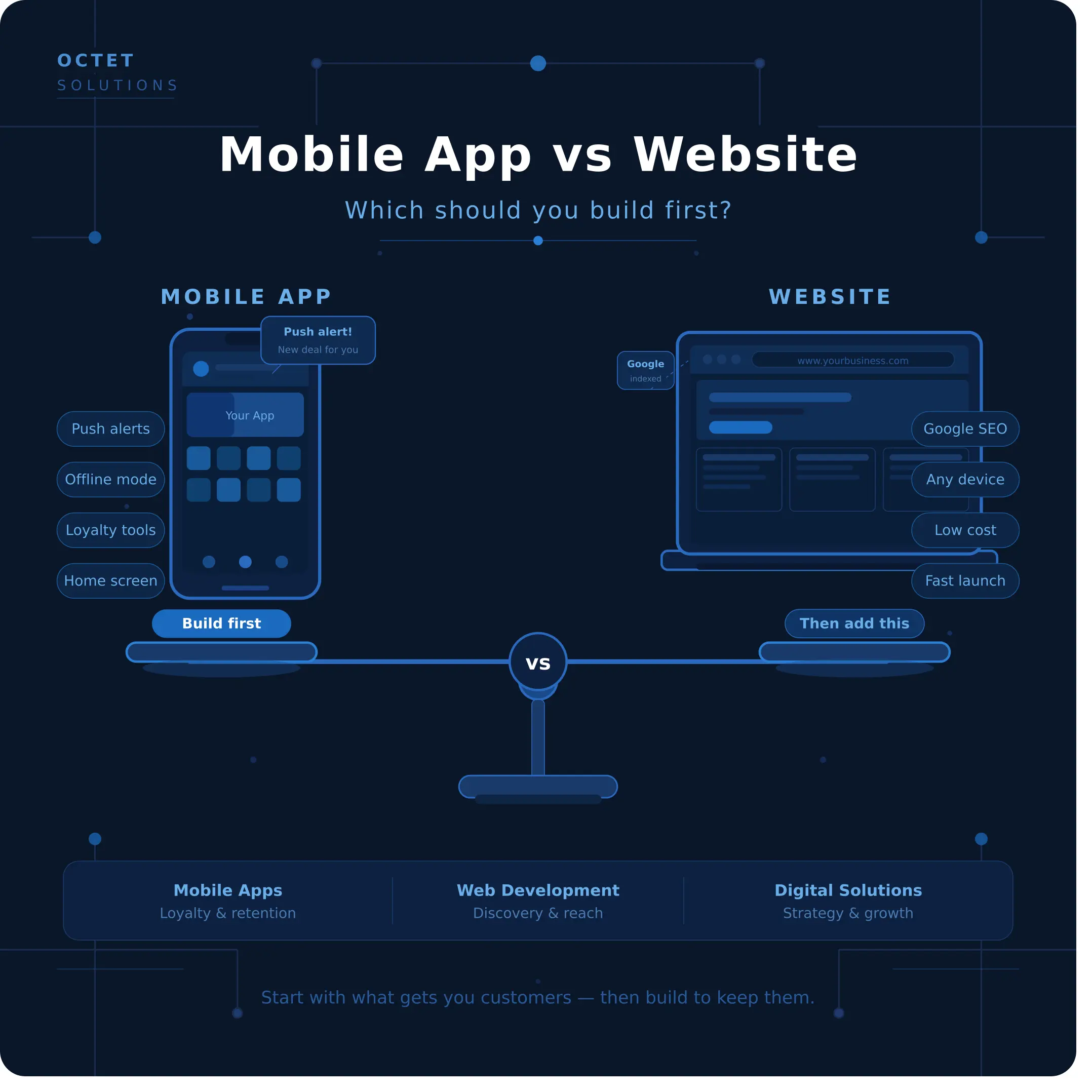
A website is how people find you. It lives on Google, gets shared over WhatsApp, and works on every device without anyone downloading a single thing. When someone searches for what you sell, your website is what shows up. That discoverability alone is worth more than most business owners realise early on.
A mobile app, on the other hand, is for people who already know you. It sits on their home screen, sends them push notifications, works offline, and pulls them back into your world regularly. It deepens the relationship with customers you already have rather than helping you find new ones.
The key is that most businesses start off from a website and move on to building apps for the long run.
What Defines Your Mobile Presence for Business
A mobile presence is about how people experience and interact with you while they’re on the move. A responsive website usually handles the basics well by making sure your business is accessible, readable, and easy to browse on any device.
A mobile app, on the other hand, goes a step further. It’s built for repeat visits, smoother interactions, and staying closer to your customers over time. Both have their place, but they support different stages of how people connect with your business.
Mobile App or Website for Business: Understanding the Benefits
Why Businesses Need a Website First
A website is your foundation. It is where people discover you, read about what you do, and decide whether to trust you. Search engines index your website. Google does not index your app.
The benefits of having a business website include:
- Discoverability, as customers searching for your service will find your website and not your app
- Lower cost because a professional website costs a fraction of what a native app costs to build and maintain
- Wider reach since it works on every device and every browser without anyone downloading anything
- Credibility as a clean, fast website builds trust immediately with new visitors
- Marketing integration for email campaigns, paid ads, and social media all point back to your website
Mobile App Benefits for Small Business
Once you have an established customer base, a mobile app adds serious value. The benefits of a mobile app for business come into play when your customers keep coming back.
A mobile app lets you send push notifications directly to your customers’ phones. You can reach them with deals, updates, and reminders without relying on them to check their email or scroll past your ad. That is a direct line of communication that no other channel gives you.
Apps also create loyalty. When your app sits on someone’s home screen, your brand stays in front of them every single day.
App vs Website for Startup: What Should You Build First?
For startups, this is the most important decision in your early digital strategy. The answer for most startups is clear: build a website first.
Here is why;
- A website lets you prove your concept with minimal investment.
- You can also launch in weeks, start collecting traffic, test your messaging, and see what your customers actually respond to.
- Then you build the app when you have data to back it up.
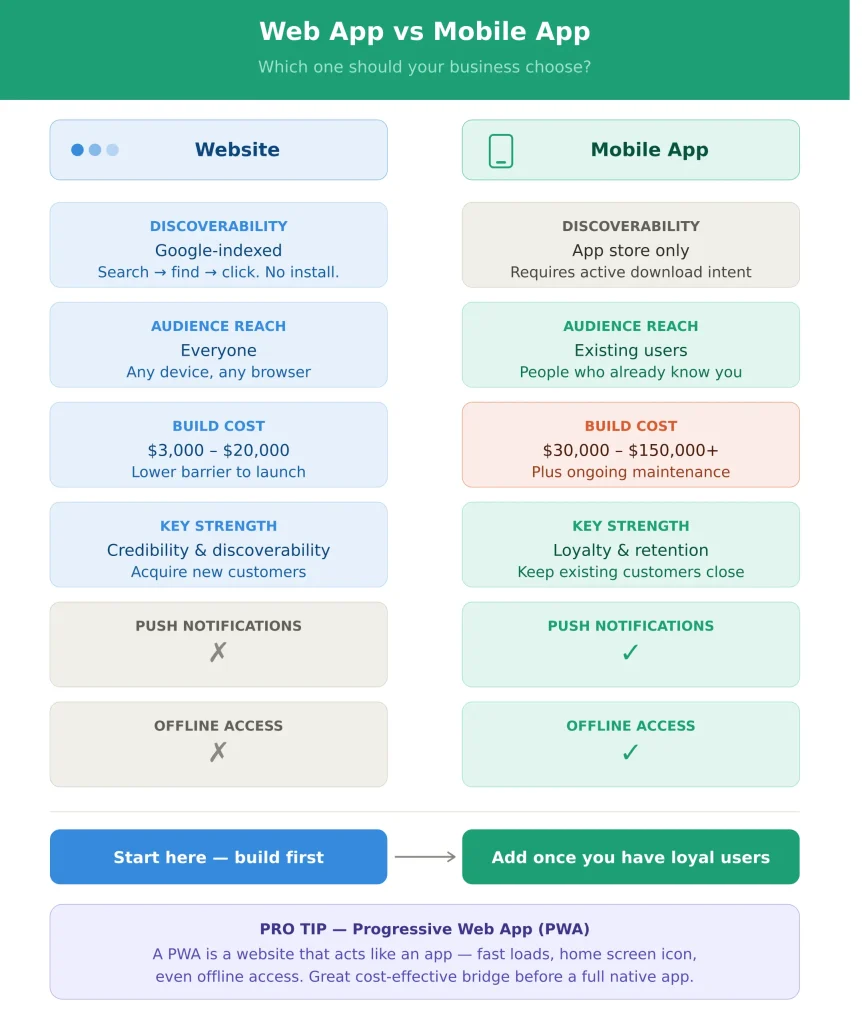
App development for startups is expensive. A well-built native app typically costs between $30,000 and $150,000 to develop. Then you need ongoing maintenance, updates for new iOS and Android versions, and a marketing budget to drive downloads. That is a lot of runway to burn before you know if the product works.
Minimum Viable Product: App or Website?
Your MVP should almost always be a website. A minimum viable product on the web is faster to ship, cheaper to iterate, and easier to change when your assumptions turn out to be wrong. Once you know what your users want, you can build the app on top of that learning.
The exception is when your product genuinely requires device-level features from day one, such as camera, GPS, offline access, or hardware integration. Instagram is the classic example. It had to be an app because the experience was entirely built around your phone’s camera. For most businesses, that is not the case.
Best Digital Strategy for Startups
A smart digital strategy for startups follows this sequence:
- Launch a responsive website to establish your presence and test your concept
- Drive traffic through SEO, content, and paid ads
- Collect data on what your users do and what they need
- Build a mobile app once you have consistent users who would benefit from one
This approach keeps your costs manageable and your decisions informed.
Which is better: a Web app or a mobile app?
Mobile App vs Website User Experience
This depends entirely on your user type. For new visitors who found you through a search, the website experience wins. They want quick answers without downloading anything. For daily active users who already love your product, the app experience wins. It is faster, smoother, and more personal.
Is a Mobile App Better Than a Website?
Let’s look at mobile app vs website development, and which is better. A mobile app is better than a website at doing specific things: push notifications, offline functionality, accessing device hardware, and retaining loyal users. A website is better at reaching new audiences, ranking on Google, and serving casual visitors.
Mobile app advantages over a website include:
- First and important of all, you get faster load times after the initial download
- Then, push notifications that reach users without them opening a browser
- Also gives offline access to content and features
- After that, better performance for complex, interactive tools
- And higher session time and engagement for loyal users
Progressive Web App vs Native App
There is a middle ground worth knowing about. A Progressive Web App (PWA) is a website that behaves like an app. It loads fast, can be added to the home screen, and even works offline in some cases. Many businesses use PWAs as a cost-effective bridge before investing in a full native app. If you want app-like features without the full cost, a PWA is worth exploring.
Mobile-First Strategy for Business
Regardless of which direction you go, a mobile-first strategy means you design your digital experience for small screens before large ones. Over 60% of global web traffic comes from mobile devices. If your website loads slowly on a phone or is hard to navigate with a thumb, you are losing customers before they even read your first sentence.
Website vs Mobile App Benefits for Business: A Direct Comparison
| Factor | Website | Mobile App |
| Cost to build | Lower | Higher |
| Time to launch | Faster | Slower |
| Discoverability | Google-indexed | App store only |
| Audience reach | Everyone | Existing users |
| Maintenance | Simpler | More complex |
| Push notifications | No | Yes |
| Offline access | Limited | Yes |
| Loyalty tools | Limited | Strong |
Customer Retention
Apps win on retention. When a customer installs your app, they are committing to your brand in a way they never do with a website. They have given you space on their phone. That is valuable real estate.
The push notification benefit for business is real. Brands using push notifications see significantly higher repeat visit rates compared to email or social media alone. You can re-engage customers with offers, remind them about abandoned carts, and send time-sensitive updates instantly.
Website Accessibility for Business
A website is accessible to everyone. There are no barriers. No app store. No device compatibility issues. A customer on an old Android phone, a Windows laptop, or a Mac can all reach your website equally. That universal accessibility matters enormously when your business is still building its audience.
Mobile App ROI for Business
The ROI on a mobile app is real, but it takes time to materialise. You need enough users to justify the maintenance cost, a clear reason for those users to download and keep the app, and features that the app delivers that your website cannot. For businesses with a loyal, repeat-purchase customer base, the ROI on a mobile app can be excellent. For businesses still building that base, the website delivers better ROI first.
App or Website for E-commerce Business
Should an E-commerce Store Have an App?
E-commerce is where the app vs website debate gets most interesting. The data here is worth paying attention to.
Mobile apps deliver around 63% higher conversion rates compared to mobile websites for e-commerce brands. That gap exists because apps remove the friction that kills sales on mobile websites, such as clunky navigation, slow checkout, and repetitive form-filling.
Mobile devices generate 57% of global ecommerce sales as of 2024, and dedicated shopping apps now handle 54% of mobile commerce transactions.
E-commerce Mobile App Benefits
For an e-commerce business that has an established customer base, a mobile app delivers:
- Faster checkout with saved payment methods
- Also gives personalised product recommendations
- Then loyalty programs and exclusive app-only offers
- After that, push notifications for flash sales and back-in-stock alerts
- And lastly, higher average order values from engaged, loyal customers
Mobile Shopping App vs Mobile Website
A mobile website handles discovery. But a shopping app handles loyalty. So, most successful e-commerce brands use both. The website catches new customers through Google and paid ads. Whereas the app keeps existing customers coming back and spending more.
Shopify App vs Website
If you run a Shopify store, your website is already mobile-responsive. That is your starting point. A dedicated Shopify mobile app becomes worth the investment once you have a customer base that shops with you repeatedly. For new stores, focus on optimising the Shopify website experience first, then look at app solutions as your customer base grows.
How Octet Solutions Can Help
Whether you are starting with a website, planning a mobile app, or exploring PWAs, choosing the right technology partner matters as much as choosing the right platform.
Octet Solutions helps in building e-commerce websites and apps for businesses at every stage of growth. They provide different kinds of development services, like MERN Stack and Flutter App development. They take the time to understand your business goals, your users, and your budget before recommending a direction.
If you are sitting with this question and want a clear, honest recommendation for your specific situation, Octet Solutions is the team to talk to.
Conclusion
So, should I build a mobile app or a website for my business? The biggest mistake businesses make is building an app too early, before they have the audience to justify it. Then the second biggest is staying website-only long after a loyal customer base has formed and is clearly ready for something better. Your platform should match where your business is right now, then grow alongside it. So, start with what gets you customers, then build towards retaining those people.
If you want a team that will look at your specific business and give you a clear, honest recommendation, Octet Solutions provides services for that and specializes in web and app development.
FAQs
Should I build an app or website first as a new business?
As a starting point, it makes sense to begin with a website. It’s quicker to launch, more affordable, and allows you to validate your idea before investing in app development.
How much does it cost to build a mobile app vs a website?
In most cases, a professional website ranges from $3,000 to $20,000. A mobile app, however, typically starts around $30,000 and can go beyond $150,000 depending on complexity.
Can a website replace a mobile app?
For many new businesses, a website is often enough in the early stages. However, as your audience grows and keeps coming back, an app starts to add value through better engagement and convenience.
Is a mobile app better for e-commerce?
Generally, yes, especially for established brands. Once customers start returning regularly, apps tend to improve conversions and loyalty. On the other hand, for new e-commerce businesses, a well-optimized mobile website is usually more practical to begin with.
How do I know when I’m ready to build an app?
Typically, you’re ready when you already have consistent repeat users, a clear need for app-specific features, and enough budget to support both development and long-term maintenance.