
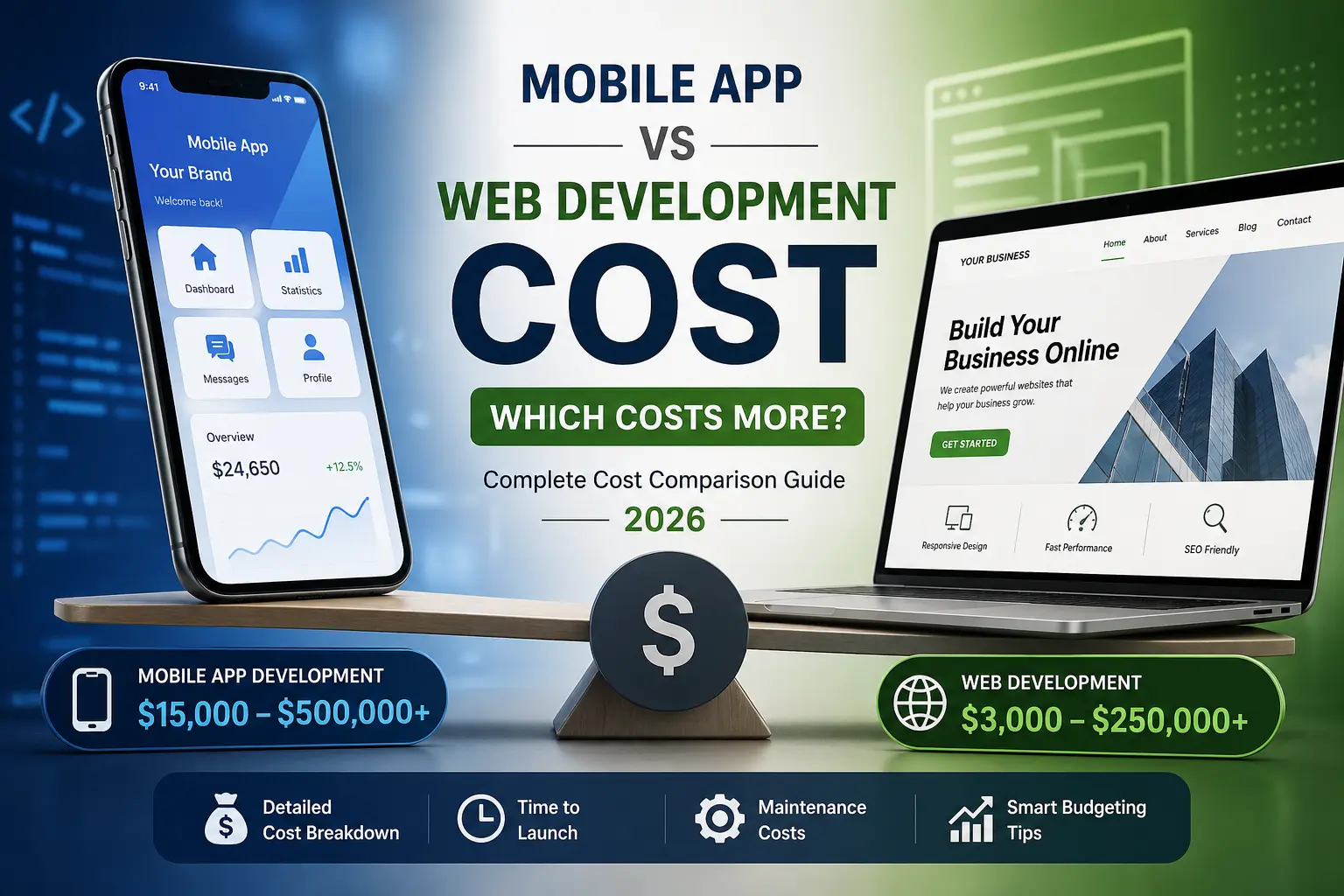
Mobile app development vs web development cost is genuinely one of the first things a business owner should figure out before going digital. It’s important for businesses that are just starting, so they don’t waste serious money on the wrong thing at the wrong time.
This is not a simple answer. The price depends on what you are building, who is building it, and what stage your business is actually at. At Octet Solutions, this is the conversation we have with clients before anything else, because the right budget starts with the right decision.
So here is a real breakdown of what things actually cost in 2026.
How Much Does Mobile App Development Actually Cost?
There is no single number here, because what you pay depends almost entirely on what you are building and how complex it needs to be from day one.
What Does a Simple App vs a Complex App Cost?
First, think of app development cost in three broad tiers. For example, a simple app, something like a local business loyalty card or a basic booking flow, will typically run you between $15,000 and $80,000. That covers standard features like user registration, a basic backend, and clean navigation.
Move up to a mid-complexity app, and you are looking at $80,000 to $150,000. That is where most Saas and e-commerce mobile apps land. You are getting custom UI/UX, payment gateway integration, API connections, user accounts, and push notifications.
Then there is the enterprise level. Real-time systems, AI features, multi-role user management, and compliance requirements. That is $150,000 to $500,000 and beyond. And once you hit that territory, the build cost is really just the beginning.
Whatever you spend on development, set aside another 15 to 20 percent of that figure every year for mobile app maintenance. OS updates, security patches, and performance work. It adds up fast, and most people do not budget for it until it is too late.
Does Building for iOS and Android Cost More?
Yes, significantly. Separate native apps for iOS and Android essentially means two separate builds, two teams, two testing cycles. That can double your investment overnight.
Cross-platform development using Flutter or React Native solves this. Flutter app development cost and React Native app development cost both tend to come in 30 to 50 percent lower than building two separate native apps. A project that might cost $120,000 as two native builds can realistically come down to $65,000 to $75,000 with a well-executed cross-platform approach. For most business apps, the performance trade-off is minimal. Cross-platform development is almost always the smarter starting point.
What Are the Hidden Costs of Mobile App Development?
This is where budgets quietly unravel. Agencies quote the development cost. They do not always lead with what comes after.
- To begin with, an Apple Developer account is $99 per year. Google Play is a $25 one-time fee.
- Backend hosting and infrastructure can run $500 to $5,000 per month, depending on traffic and scale.
- Then QA and testing should be 10 to 15 percent of your development budget. Skip this, and you will pay five times more to fix bugs post-launch.
- Lastly, there are user acquisition costs because the app does not market itself, and downloads do not happen on their own.
Add all of this up, and your realistic first-year total is often one and a half to two times the original development quote. Hence, plan for that upfront, and you will not be caught off guard six months in.
How Much Does Each Feature Add to the Cost?
Mobile app development cost per feature is a useful way to think about scope before committing to a full build. Here is roughly what common features add to a project:
- User authentication and profiles: $3,000 to $8,000
- Payment gateway: $5,000 to $15,000
- Real-time messaging: $10,000 to $25,000
- GPS and mapping: $8,000 to $20,000
- Push notifications: $3,000 to $7,000
- AI-powered recommendations: $20,000 to $60,000 and above
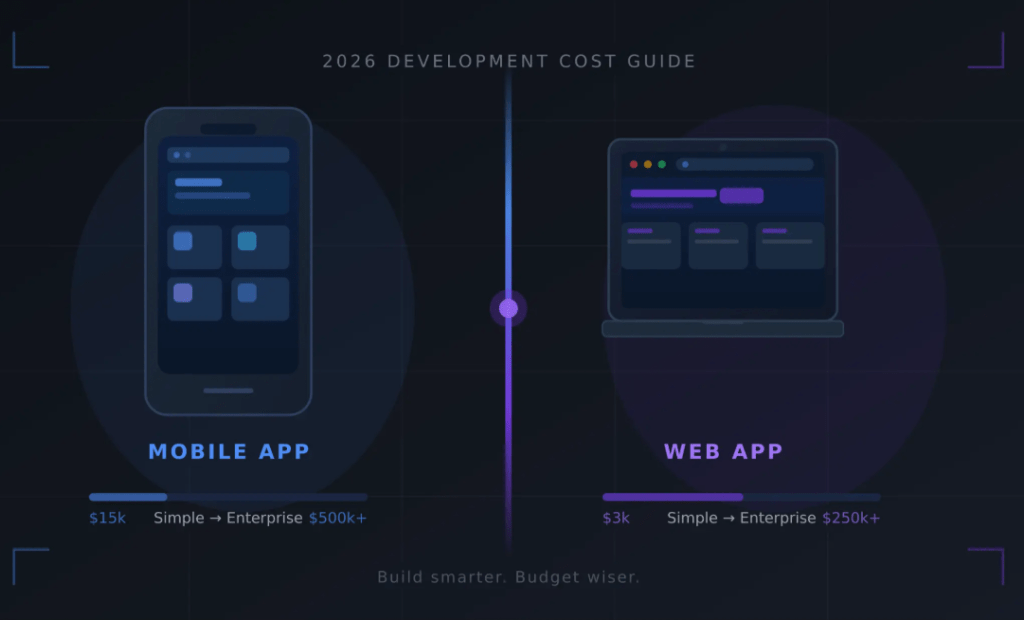
Every feature also carries forward into the mobile app maintenance cost per year. The fewer features you launch with, the less you spend upfront and the less you carry going forward. This is why most experienced teams push for an MVP first rather than trying to build everything at once.
How Much Does Web Development Cost in 2026?
It costs way less than app development, almost across the board. But the range is still wide, so it helps to understand where your project actually sits.
What Does a Business Website Cost at Different Scales?
A basic five to fifteen-page business website, with custom design, mobile responsiveness, and basic SEO, typically runs $3,000 to $15,000. For a growing business that needs a content management system, more complex page templates, and conversion-focused design, you are looking at $15,000 to $45,000.
However, E-commerce website development cost for a small business starts around $10,000 and can push well past $150,000 depending on catalog size and payment complexity. It also depends on how much customisation the shopping experience requires; for instance, enterprise web platforms sit at $75,000 to $250,000 and above.
Now, the average web developer hourly rate in 2026 ranges from $20 to $50 per hour with offshore teams and $100 to $300 per hour with US or UK agencies. That gap is exactly why outsourcing web development is such a common strategy for businesses that want quality without paying Western market rates for it.
What Actually Drives Website Development Cost Up?
Most businesses go into a web project thinking it is simpler than it is. Then scope creep hits. Here is what usually drives the gap between an initial quote and the final invoice.
Design complexity is the first thing. Template-based builds save money. Custom UX research and visual design can add 20 to 40 hours of work before a single page gets built. Then there are third-party integrations. CRMs, email platforms, payment systems, and analytics tools. Each one requires integration work that rarely gets included in the base quote upfront.
The other thing people consistently miss is what affects website development cost after launch. A professional website needs $3,600 to $24,000 per year in hosting, security updates, and performance work. This is the cost most businesses discover too late, usually when the site slows down or a security issue surfaces.
Mobile app development vs web development cost: Which One Is Actually Cheaper?
A Website is almost always more affordable than mobile apps. So, here is the comparison laid out plainly.
| Category | Website | Mobile App |
| Entry-level | $3,000 to $15,000 | $15,000 to $80,000 |
| Mid-range | $15,000 to $45,000 | $80,000 to $150,000 |
| Enterprise | $75,000 to $250,000+ | $150,000 to $500,000+ |
| Time to launch | Weeks | Several months |
| Annual maintenance | $3,600 to $24,000 | 15 to 20% of the build cost |
| Updates | Instant | Requires app store review |
Why Is Mobile App Development More Expensive Than a Website?
Because an app is a more complex product to build. It needs platform-specific engineering, rigorous testing across device types and OS versions, and app store compliance. Other than that, it also needs a backend that supports offline functionality, push notifications, and device-level integrations.
A website lives in a browser, but an app lives on a device. That distinction carries real engineering weight, and it shows up directly in what you pay.
Progressive Web App Cost vs Native App: Is There a Middle Ground?
There is. A Progressive Web App, or PWA, sits between a website and a native app. It runs through the browser but behaves like an app. Users can add it to their home screen, get push notifications, and use some features without a connection.
The PWA vs native app cost comparison is meaningful. A well-built PWA typically costs $20,000 to $60,000, far less than a native app, and it bypasses the app store approval process entirely. For businesses that want app-like functionality without the full commitment, a PWA is a practical option that does not get enough attention.
How Do You Budget for App Development Without Overspending?
This really comes down to one thing: build less upfront, then grow from what you actually learn.
What Is an MVP and Why Does It Save Money?
An MVP, or Minimum Viable Product, is the smallest version of your product that delivers real value to real users. You are not cutting corners. You are being deliberate about what you build first and what you build later.
MVP app development cost is significantly lower than a full-featured product because you are only building what is essential at launch. Then you iterate based on actual user behaviour rather than assumptions. This approach can reduce your initial investment by 40 percent or more and gives you something real to test before committing to the full vision.
For most startups, a website or web app MVP makes more financial sense than a native app. Validate first. Build the app when you know there is an audience worth building for.
How Do You Reduce App Development Cost Without Losing Quality?
A few decisions made early can save significant money without touching quality at all.
Choose cross-platform over two separate native builds. Flutter and React Native reduce both mobile app vs website development time and total spend while covering both platforms. Define your integrations before development starts, not during. Adding a payment gateway mid-project costs considerably more than scoping it at the beginning. And take QA seriously from the start. Post-launch bug fixes cost five times more than catching the same issues during development. That is not a small difference when you are talking about a $100,000 project.
Freelance App Developer vs Agency: Which Costs Less Overall?
Freelancers charge less per hour, typically $20 to $65 for experienced developers in competitive markets. But for anything beyond a simple project, the lack of coordination across design, backend, and frontend adds hidden costs through revisions, delays, and miscommunication.
Agencies cost more but bring a full team, project management, and accountability across the entire build. For most serious apps and business websites, the agency model produces more predictable results and fewer expensive surprises at the end.
A hybrid approach works well when the budget is constrained. Use an affordable app development company for execution and bring in a local consultant or strategist for scope and direction. That balance keeps costs competitive without losing control of the project.
How Does Octet Solutions Help You Get the Budget Right?
Before Octet Solutions writes a single line of code, the team works out what you actually need to build. That sounds obvious, but it is rarer than it should be.
Whether the right move is a MERN Stack web application, a Flutter mobile app, a PWA, or a phased approach that starts with a website and scales toward an app, the goal is to match the investment to the actual business need rather than recommend complexity that does not serve the goal yet. Octet works with businesses at every stage, from startups validating ideas to established companies planning their next product, and the starting point is always the same: scope it honestly, price it accurately, and build it in a way that delivers actual returns.
Conclusion
Mobile app development vs web development cost really comes down to what your business needs right now. Websites are cheaper, faster to launch, and the right starting point for most businesses. Apps cost more, take longer, and deliver significantly more when you have an audience that is ready for one.
The mistake most businesses make is building the more expensive thing before they have validated the need for it. A startup that spends $120,000 on a native app before proving their product works is in a worse position than one that builds a $15,000 website, grows a real customer base, and then builds the app with data behind every decision.
Get the sequence right, and both investments pay off. Rush the sequence, and neither one will.
FAQs
How much does it cost to build a mobile app in 2026?
A simple MVP? $15K–$80K. Mid-complexity with payments and user logins? $80K–$150K. Enterprise-level with AI or real-time features? $500K and up.
Is it cheaper to build an app or a website?
Hands down, websites win on price, starting at $3K–$15K for business sites. Apps kick off at $15K and climb fast. Average web dev in 2026 runs $5K–$45K for pro sites, or $100K+ for custom ecommerce.
Why is mobile app development pricier than web dev?
Apps need platform-specific code, testing across every device and OS, app store approvals, and heavy backends. Websites just load in a browser.
Can you really build an app for under $5K?
Not with a solid team. No-code tools handle basics there, but with real backend or integrations, costs spike quickly.
What drives mobile app development costs the most?
Feature complexity, platform choices, design polish, backend needs, third-party integrations, and your dev team’s experience/location.
How much is yearly app maintenance?
Budget 15-20% of the build cost, like $15K-$20K on a $100K app. The first year often hits higher with tweaks and feedback.
How do you cut app dev costs without cutting corners?
Start with an MVP, pick cross-platform tools, lock in requirements early, and prioritize QA. Speaking of savings, that approach keeps quality high.