Why Custom Software Development Is Becoming Essential for Modern Businesses
Custom software development isn’t usually the first thing businesses think about.
They start by relying on ready-made tools. And that makes sense. Because these tools are quick to set up and easy to use, they keep daily operations running without friction.
However, the problem arises when the business starts growing. As operations expand, processes become more specific. At the same time, teams take on more responsibilities, and expectations naturally increase. Because of this, the same tools that once worked well begin to feel less aligned with how the business actually functions.
That’s usually the point where making changes becomes important. This is where custom software development starts to make sense; not as a replacement for tools, but as a more structured way to support how the business actually works.
What Is Custom Software Development?
Custom software development refers to building, designing, and deploying the kind of software your company needs. It’s made to fit your organisation’s requirements. Simply put, building software that fits your business instead of forcing your business to fit someone else’s software. Now that sounds basic, but it changes everything.
Because instead of working around limitations, you build something that actually matches your workflows. That’s where custom software solutions stand out.
They are not built for “everyone.” They are tailored for your team, your operations, and your goals.
In many cases, this includes:
- internal systems
- dashboards
- automation tools
- or full platforms through custom application development
Why Businesses Are Shifting towards it
The shift occurs when you start noticing small problems in your daily work.
Most businesses begin with ready-made tools because they’re quick and affordable. At that stage, they work fine.
But as the business grows, those tools stop matching how things actually run.
You start noticing small problems like:
- Teams updating the same data in multiple places
- Or systems that don’t sync properly
- And some reports are taking extra steps to generate
None of this feels critical on its own. But it slows everything down in practice. Over time, work stops feeling connected. Each team is using tools that don’t really work well with each other.
That’s why businesses need custom software development. This way, instead of patching the problem with more software, businesses start looking at building something that actually fits their workflow.
Benefits of Custom Software Development
Once that realization hits, the benefits start showing up in day-to-day work. Things feel a bit easier, tasks don’t drag as much, and teams aren’t stuck fixing the same issues over and over.
Here’s what actually changes:
- Everything feels more aligned: Off the shelf softwares might have some limitations. But if we talk about custom software, it matches your objectives and workflows.
- Manual work drops: You don’t have to do more manual work since all the tasks get automated, which helps save your time for important tasks and planning.
- Systems connect better: Custom software is built in a way that it’s compatible with your existing tools, so you won’t have a problem integrating it with other tools smoothly.
- Scaling becomes easier: You’re not stuck switching platforms every time you grow, because customised software does all the adjustments for you.
- Long-term costs improve: Yes, the cost of custom software development is higher upfront. But over time, it reduces tool clutter and inefficiencies.
So instead of juggling tools, you run everything through one system that actually makes sense.
Custom Software vs Off-the-Shelf Software
Before comparing the two, it’s important to understand what we’re really talking about in simple terms.
Off-the-shelf software:
Off-the-shelf software is usually a ready-made tool that’s built for a wide range of users, so it comes with general features that can work for many businesses, but not perfectly for any one specific way of working. It’s basically:
- Quick to start
- Have a lower upfront cost
- And has limited flexibility
Custom software:
Custom software, on the other hand, is built specifically for one business. Because of that, it follows the company’s actual processes:
- They match your workflows.
- Then they’re also more flexible and can easily scale with the business.
- And they support long-term use.
At first, ready-made tools feel easier. But over time, they force compromises.
That’s where bespoke software development makes the difference.
It removes those compromises instead of working around them.
How the Custom Software Development Process Works
So how does it actually come together?
The custom software development process is structured, but not rigid.
It usually flows like this:
- Discovery: First of all, the team understands your business, not just your requirements.
- Planning: Then, features, timelines, and priorities are defined clearly.
- Design: After that, the focus shifts to how users will interact with the system.
- Development: This is where custom application development happens.
- Testing: Everything is checked along the way, not just at the end.
- Launch + updates: Then, finally, the system goes live and keeps improving over time.
That’s why many companies prefer full-cycle software development.
It keeps everything connected from start to finish.
Choosing the Right Development Approach
Now comes another important decision. Do you build internally or bring in experts?
Here are common options:
- Hire custom software developers as they’re good for long-term internal control.
- Outsource custom software development for a faster and often more cost-effective approach.
- Work with a dedicated software development team since it’s a balanced approach with flexibility and expertise.
But beyond that, one question matters most:
How to choose a software development company?
A good custom software development company tries to understand how your business actually works. And then it builds something that fits your process, instead of forcing you to adjust to the software. For that, there are certain things you’ll have to look for in a company:
- If they have real experience
- Or are they clear in communication
- Then see if they have an understanding of your business
Custom Software for Startups and Enterprises
Not every business needs the same approach.
For startups:
For startups, they usually focus on how fast they can get things done, so they’re looking for speed. That’s why custom software development for startups focuses on:
- MVPs
- quick launches
- fast iterations
A strong custom software development company for startups helps validate ideas quickly.
For enterprises:
However, for bigger enterprises, priorities shift, since the systems become more complex and widespread, for which they need:
- Stability
- Integration
- And scalability
That’s where enterprise custom software development comes in.
And more specifically, enterprise custom software development solutions handle complex systems smoothly and keep them running even as scale and demand increase.
Examples of Custom Software Solutions
These are not just tools; they are systems that businesses build around real needs. To make it clearer, here’s how businesses actually use it:
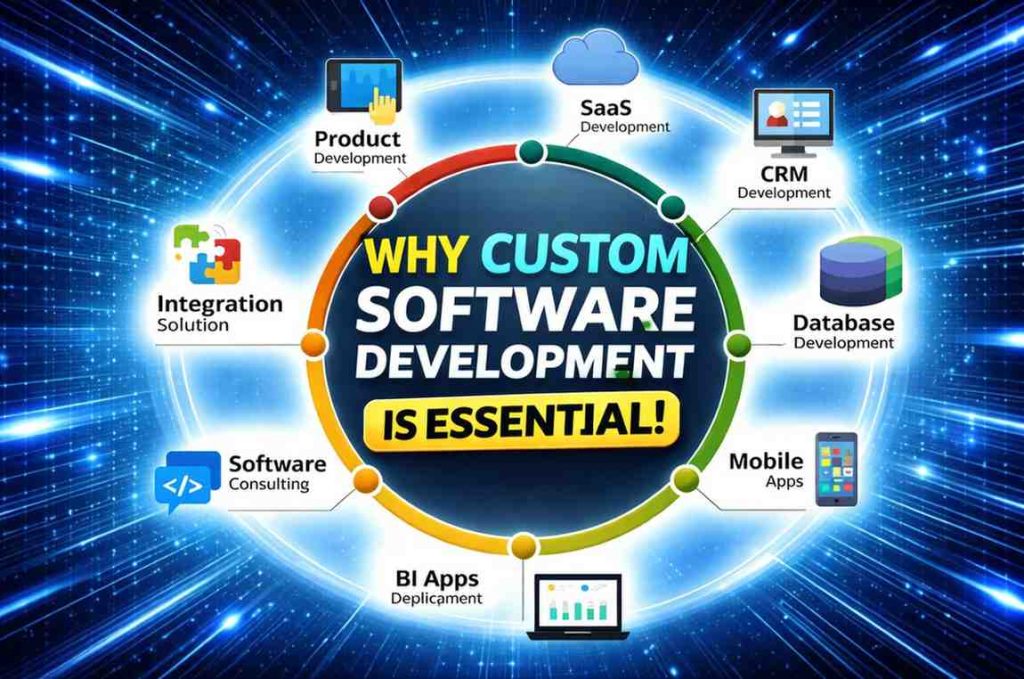
- First, they manage customers with custom CRM software development services
- Then, run operations with custom ERP software development company solutions
- Also, build platforms through a custom SaaS development company
- After that, create flexible systems with custom web-based software development
- And lastly, scale easily using cloud-based custom software solutions
Custom Software Development Trends 2026
Things are evolving quickly. Some key custom software development trends 2026 include:
- Cloud-first systems are becoming standard
- Then there’s a stronger focus on security
- And AI is being integrated into workflows
At the same time, businesses are investing more in software product development services that are built to scale from day one.
How Octet Solutions Helps Businesses Build the Right Systems
By now, the need for better systems is clear. But actually building the right system is the real challenge. That’s where Octet Solutions comes in as a custom software development firm. Instead of jumping straight into development, the focus starts with understanding:
- what’s not working
- where the gaps are
- What actually needs fixing
From there, the solution is built step by step.
And whether it involves custom software development, web and mobile applications, AI-driven systems, or scalable enterprise platforms, the aim stays the same: build something that actually works in real conditions today and continues to support growth in the future.
Alongside this, they also run a training institute that offers practical, industry-focused courses, but their core strength remains in building real software solutions for businesses.
Conclusion
Custom software is no longer just for large companies. More businesses are moving toward tailored systems because generic tools can only take them so far. As complexity grows, the need for better systems becomes obvious. That’s exactly where custom software solutions make a difference. They don’t just fix problems. They help businesses move forward with clarity and control.
FAQs
1. What is custom software development in simple words?
Custom software development is when you develop software specifically for your business instead of using a general tool that every business uses.
2. Why do businesses need custom software?
Businesses need it because ready-made tools often become limited as they grow. Custom software fits better with their workflows and reduces inefficiencies.
3. Is custom software expensive?
Yes, it usually costs more at the start. However, over time, it saves money by reducing manual work and tool overload.
4. How long does custom software take to build?
It depends on the complexity. Simple systems can take a few weeks, while larger enterprise systems can take several months.
5. Can startups use custom software?
Yes, startups often use custom software to quickly build MVPs and test their ideas in real markets.
6. What is the difference between custom and off-the-shelf software?
Off-the-shelf software is ready-made for general use, while custom software works for one business and its needs.